

Why Finding the Safest Infant Lounger Matters More Than Ever

Finding the safest infant lounger for your baby has never felt more urgent — or more confusing. In 2025, three infants died in baby loungers reported to the Consumer Product Safety Commission (CPSC). In February 2026, another infant death was linked to a baby lounger. And despite landmark new federal safety standards that took effect in May 2025, unsafe loungers are still widely available online and in secondhand markets.
Here's what you need to know right now:
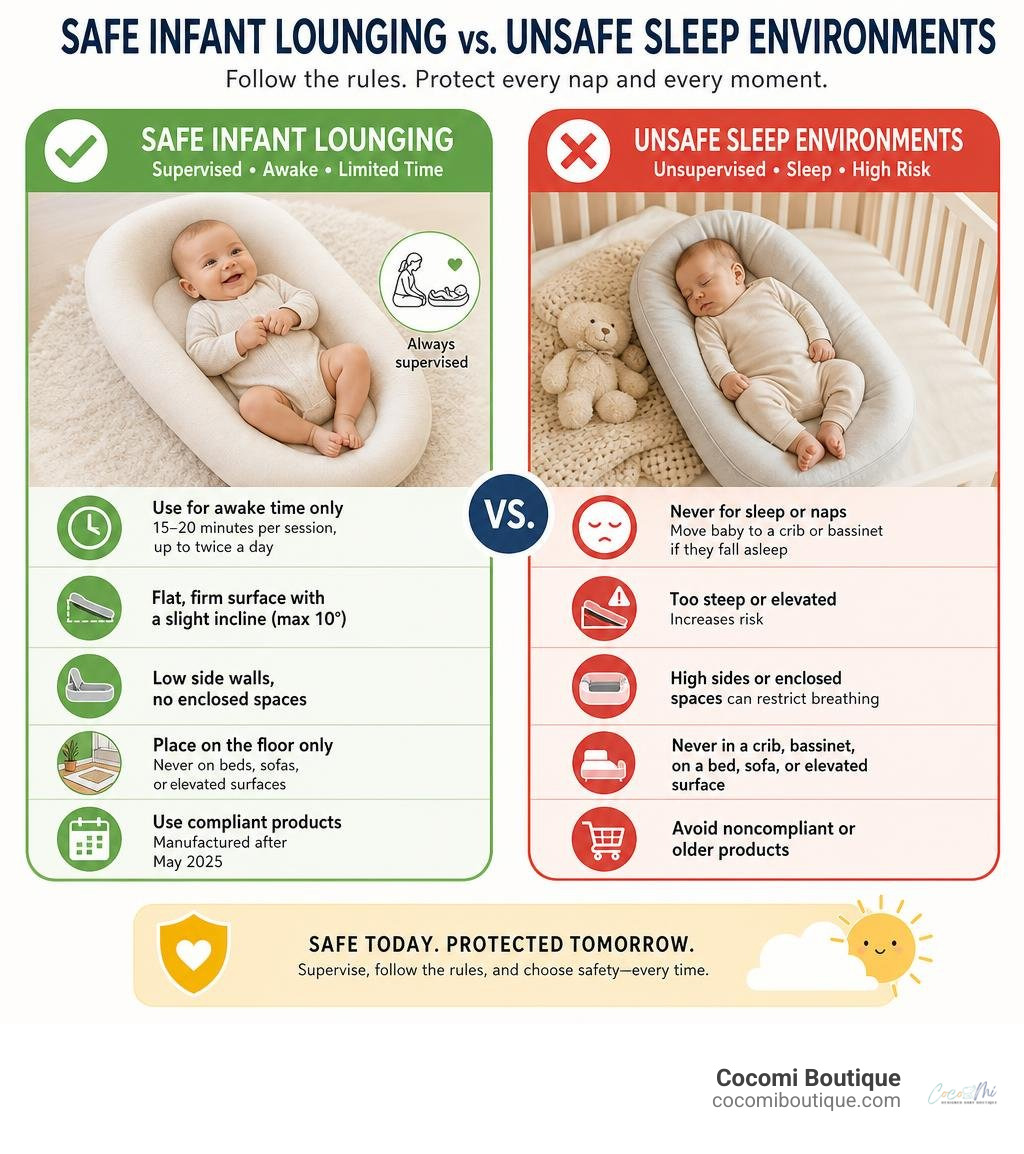
- Infant loungers are strictly for supervised awake time only — never for sleep, naps, or unsupervised rest
- A compliant lounger must meet CPSC standard 16 CFR Part 1243, which requires a maximum 10-degree incline, low side walls, and a firm, flat surface
- If your baby falls asleep in a lounger, move them immediately to a firm, flat crib or bassinet
- Limit lounger use to 15–20 minutes per session, up to twice a day
- Never place a lounger inside a crib, bassinet, or on an elevated surface like a couch or bed
- Check the manufacture date — only products made after May 2025 are required to meet the updated safety rules
- Avoid products marketed with terms like "co-sleeper," "womb-like," or "sleep support" — these are red flags
The challenge is that even well-meaning parents can be misled. The CPSC facilitated the removal of over 106,000 dangerous product listings from online marketplaces in just the first few months of 2026 alone — up from 67,647 in all of 2025. Old, noncompliant designs are still circulating through third-party sellers, garage sales, and neighborhood buy-and-sell groups.
I'm Monika Jarog, founder of CocoMi Boutique, where I handcraft baby essentials from 100% natural, chemical-free materials that meet the highest European safety standards — because when it comes to the safest infant lounger and every product near your newborn, nothing less is acceptable. In this guide, I'll walk you through exactly what the new standards mean, how to spot a compliant product, and what safer alternatives exist for your baby's supervised rest and play.
Basic safest infant lounger vocab:
The Blueprint of the Safest Infant Lounger: Understanding the 2025 CPSC Standards
To understand what makes a lounger safe, we first have to look at how the regulatory landscape shifted. For years, the baby product market was flooded with plush, pillow-like nests with high, pillowy walls and steep inclines. While they looked incredibly cozy to a sleep-deprived parent, safety advocates and pediatricians warned that these exact features posed severe risks.
The introduction of the mandatory federal safety rule for infant support cushions, known as 16 CFR Part 1243, changed the rules of the game. According to Consumer Reports on updated safety rules, this regulation was designed to fundamentally alter how these products are constructed to prevent suffocation, airway obstruction, and rollover accidents.
To help you visualize how much the design requirements have changed, look at the differences between legacy designs and modern, compliant safety standards:
| Design Feature | Legacy Lounger Designs (Pre-May 2025) | 16 CFR Part 1243 Compliant Designs |
|---|---|---|
| Maximum Incline | Often 15 to 30 degrees | Strictly 10 degrees or less |
| Side Wall Height | High, plush barriers (4 to 6+ inches) | Low-profile (maximum 2 inches) |
| Side Wall Angle | Vertical or hugging inward | Angled outward, away from the infant |
| Surface Firmness | Soft, pillowy, sink-in fiberfill | Firm, high-density supportive base |
| Center Design | Padded, hammock-like center | Unpadded center sling or firm recessed base |
| Safety Labeling | Minimal, easily removable tags | Prominent, permanent suffocation warnings |
These changes are not just cosmetic; they are engineered specifically to keep your baby's airway open and prevent them from rolling into soft, suffocating fabric.
The Shift in Infant Support Cushion Regulations
The road to these updated standards was paved with years of advocacy and tragic statistics. Before the May 2025 enforcement date, infant loungers existed in a regulatory gray area. Because they were technically marketed for "awake time" rather than "sleep," they bypassed the strict federal guidelines applied to cribs and bassinets.
However, safety regulators realized that tired parents would naturally use these comfortable-looking cushions to soothe a fussy baby to sleep. By establishing 16 CFR Part 1243, the CPSC closed this loophole, requiring any cushion intended or likely to be used for infant support to meet rigorous physical testing. For more details on the evolution of these products, read More insights on safe sleep loungers.
Key Design Changes: Incline, Height, and Firmness
If you are evaluating a lounger today, three physical characteristics dictate its safety:
- The 10-Degree Incline Limit: Any product with an angle greater than 10 degrees is unsafe for an infant to rest on. When a newborn's head is elevated on a steep incline, their heavy head naturally drops forward toward their chest. Because their neck muscles are weak and their trachea is as soft as a drinking straw, this chin-to-chest position can fold and completely block their airway—a silent, deadly condition known as positional asphyxia.
- The 2-Inch Height Limit: Compliant loungers feature a low-profile design. High side walls create a "well" that can trap exhaled carbon dioxide, leading to rebreathing. Low sides ensure constant, fresh airflow around your baby's face.
- Firmness and Surface Tension: Soft, plush surfaces are a major hazard. If a baby rolls slightly or turns their head in a pillowy lounger, the fabric can contour around their nose and mouth, causing suffocation. The safest infant lounger will feel surprisingly firm, utilizing high-density foam or an unpadded center sling that allows the baby to absorb the firm, flat surface of the floor beneath them.

Navigating the Market: Compliance, Red Flags, and Safe Usage Best Practices
Even with strict rules in place, shopping for a baby lounger in 2026 requires detective work. The internet has made it incredibly easy for overseas direct-to-consumer manufacturers to sell directly to American parents through major online marketplaces.
These manufacturers often bypass federal safety checks entirely. When the CPSC issues a safety warning or forces a recall, these sellers play a frustrating game of "whack-a-mole"—simply renaming their storefront, tweaking the product listing, and continuing to sell the exact same non-compliant, dangerous inventory to unsuspecting families.
How To Shop for the Safest Infant Lounger and Avoid Counterfeits
When you are looking for a safe option, do not rely solely on a product’s aesthetic appeal or a glowing social media review. Instead, look for physical proof of compliance:
- Check for a Tracking Label: Federal law requires all durable infant products to have a permanent tracking label. This label must display the manufacturer’s name, the location of assembly, and the exact date of manufacture. If a lounger lacks this label, do not buy it.
- Verify the Manufacture Date: Any lounger manufactured before May 2025 is highly likely to be a legacy, non-compliant design. If you are shopping online or looking at secondhand options, verify that the product was made after this date.
- Avoid the Secondhand Trap: We completely understand the temptation to save money by purchasing baby gear secondhand. However, thrift stores, garage sales, and online neighborhood groups in areas like Northbrook, Glenview, or Highland Park are still filled with recalled, outdated loungers. The CPSC has issued urgent warnings, such as the CPSC warning on non-compliant loungers, advising parents to immediately stop using and physically destroy non-compliant models to keep them out of circulation. For a step-by-step breakdown on selecting safe gear, check out our Guide to choosing the best baby lounger.
Marketing Red Flags: Words and Imagery to Avoid
Because regulatory bodies monitor specific safety claims, some brands use clever, evasive language to appeal to exhausted parents. Be highly skeptical of products using these marketing terms:
- "Co-sleeper" or "Bed-sharing nest"
- "Snuggle bed" or "Sleep support"
- "Womb-like comfort for overnight rest"
- "Breathable mesh sides for safe sleep" (Note: No matter how breathable a fabric claims to be, a lounger is never safe for sleep!)
Additionally, ignore styled nursery photos on Instagram or Pinterest. You will often see beautiful photos of sleeping babies nestled in plush loungers inside cribs, on parent beds, or on cozy couches. These images are highly unsafe and violate every pediatric safety guideline. To learn more about the reality behind these marketing claims, read our article Unpacking baby nest safety and benefits.
Why Even the Safest Infant Lounger is Strictly for Awake Time
Let's clear up a common misconception: there is no such thing as a "safe sleep" infant lounger. Even if a product is 100% compliant with the latest 2025 standards, it is still only intended for supervised, awake time.
When a baby is awake, they are constantly moving, adjusting their head, and signaling discomfort. When they fall asleep, their muscle tone relaxes completely. If their head slumps forward or their face presses against a side wall, they cannot rescue themselves. Furthermore, soft, padded environments can trap exhaled air, causing the baby to breathe in their own carbon dioxide (rebreathing), which quickly deprives their brain of oxygen. To understand the science behind these risks, read The truth about newborn snuggle nests.
The ABCs of Safe Sleep and Immediate Transition Protocols
To keep your newborn safe, always return to the gold standard of pediatric sleep safety: the ABCs of Safe Sleep.
- A - Alone: The sleep space should be entirely bare. No pillows, no blankets, no stuffed animals, no bumper pads, and absolutely no loungers or nests.
- B - Back: Always place your baby on their back for every sleep session, both naps and nighttime.
- C - Crib: The baby should sleep in a certified, flat, firm crib, bassinet, or play yard that meets federal safety standards (such as CPSC 16 CFR Part 1218).
If you are practicing room-sharing—which the American Academy of Pediatrics (AAP) recommends for the first six months—keep a firm, flat bassinet right next to your bed. To learn more about local safety initiatives and guidelines, check the Chicago infant sleep safety guidelines.
The Immediate Transition Protocol: If you set your awake baby in a lounger to fold laundry or drink your morning coffee, and you notice their eyelids starting to droop, you must act immediately. Do not wait for them to fall into a deep sleep. Gently pick them up and transfer them to their crib or bassinet. It might wake them up, and they might protest, but a crying baby safely resting in a bare crib is always infinitely better than a quiet baby sleeping in an unsafe environment.
Safer Alternatives for Supervised Play and Rest
As parents, we have all experienced the "siren call" of the infant lounger. You need to take a quick shower, make lunch, or simply give your arms a break. It is completely natural to want a cozy, secure "docking station" for your baby.
Fortunately, you do not have to rely on risky, over-padded containers. There are beautiful, functional, and completely safe alternatives that support your baby's physical development while keeping them safely by your side. For a comprehensive look at portable daytime rest solutions, explore our Complete guide to portable infant loungers.
Premium Muslin Swaddles and Blankets for Tummy Time
One of the best things you can do for your baby’s physical and cognitive development is to get them out of "containers" (loungers, bouncers, car seats) and onto the floor. Keeping a baby in movement-restricting devices for too long can lead to plagiocephaly (flat head syndrome) and delayed motor milestones, such as rolling and crawling.
Instead of a lounger, lay down a premium, multi-layered organic cotton or linen blanket on a flat, firm floor. This setup provides the perfect, non-slip surface for supervised floor play and daily tummy time.
When you choose 100% natural, OEKO-TEX certified fabrics, you can rest easy knowing your baby’s sensitive skin is resting on materials free from toxic flame retardants, heavy metals, and harsh chemical residues. To understand how to balance floor play with resting spaces, read our guide on Decoding safe sleep vs. baby nests.
Handcrafted Moses Baskets for Elegant, Supervised Rest
If you are looking for an elegant, traditional, and highly practical alternative for supervised daytime rest, a handcrafted Moses basket woven from natural palm leaf or organic cotton cord is a gorgeous choice.
Unlike soft, unstructured loungers, a high-quality Moses basket provides a firm, flat, and enclosed resting space. When paired with a firm, breathable mattress and a tightly fitted organic sheet, it offers a secure and beautiful spot to keep your baby close while you move from the living room to your home office.
Because they are lightweight and highly portable, they fit seamlessly into the active routines of busy families in communities like Deerfield, Glencoe, or Winnetka, keeping your little one safe, comfortable, and beautifully styled.

Frequently Asked Questions About Infant Lounger Safety
Navigating infant safety can feel overwhelming. Here are direct, clear answers to the most common questions we hear from parents in our Northbrook boutique and online community.
What should I do if my baby falls asleep in a lounger?
You must immediately transition them to a safe sleep surface, such as a crib, bassinet, or play yard. Even if you are sitting right next to them, watching them breathe, sleeping in a lounger is highly dangerous.
Positional asphyxiation and silent suffocation can happen in seconds without a sound or struggle. Do not risk it. Gently lift your baby, keep their body straight, and place them flat on their back in a bare sleep environment. For more practical safety tips, consult the Babylist guide on lounger safety basics.
How do I safely dispose of an outdated or recalled baby nest?
If you own an older, soft, highly inclined, or recalled infant lounger, do not donate it, sell it, or give it away to another parent. Passing an unsafe product along puts another baby's life at risk.
The CPSC recommends following a strict physical destruction protocol before throwing it away to ensure no one pulls it out of a trash bin:
- Use a pair of heavy-duty shears to cut up the outer fabric cover.
- Cut the inner foam core or fiber filling into multiple small, unusable pieces.
- Cut up any side bumpers, straps, or buckles.
- Place the shredded pieces into a dark trash bag and discard them in your household waste or textile recycling.
By destroying the product, you ensure that it can never be used again. For more insights on identifying and managing older nests, see our article Unpacking baby nest safety and benefits.
Can infant loungers cause developmental delays?
Yes, if they are overused. Pediatric experts refer to the issues caused by keeping babies in movement-restricting devices for extended periods as "Container Baby Syndrome."
When a baby is nestled in a tight, soft lounger, they cannot easily turn their head, kick their legs, push up with their arms, or engage their core muscles. This lack of active movement can lead to flat spots on the back of the head (plagiocephaly), tight neck muscles (torticollis), and delays in reaching key motor milestones like rolling, sitting, and crawling.
To prevent this, limit your baby’s time in any container—including loungers, swings, and bouncers—to no more than 15 to 20 minutes at a time, up to twice a day, and prioritize plenty of active, supervised floor play instead. For advice on balancing container use with active play, read our Guide to choosing the best baby lounger.
Conclusion
At CocoMi Baby Boutique, we believe that you should never have to choose between keeping your baby safe and styling a beautiful, elegant home. Our boutique was founded by parents who experienced how difficult it can be to find baby essentials that are genuinely natural, safe, and thoughtfully designed.
Whether you are visiting our physical boutique in Northbrook, IL—serving families across Chicago, Glenview, and Highland Park—or browsing our online store from the comfort of your home, our mission remains the same. Every single item in our carefully curated collection, from our organic muslin swaddles to our handcrafted Moses baskets, is made with natural, chemical-free materials and certified to the highest European OEKO-TEX safety standards.
As you navigate your parenting journey, the safest infant lounger is one that is used mindfully, strictly during supervised awake hours, and on a firm, flat floor. For your baby's rest, embrace the simple safety of a bare crib or a beautifully crafted, firm Moses basket. We invite you to Explore our premium baby collection today to discover safe, natural, and elegant essentials designed to give your little one the gentlest, healthiest start in life.