

Understanding Safety Risks and CPSC Regulations for a Lounger for Newborn
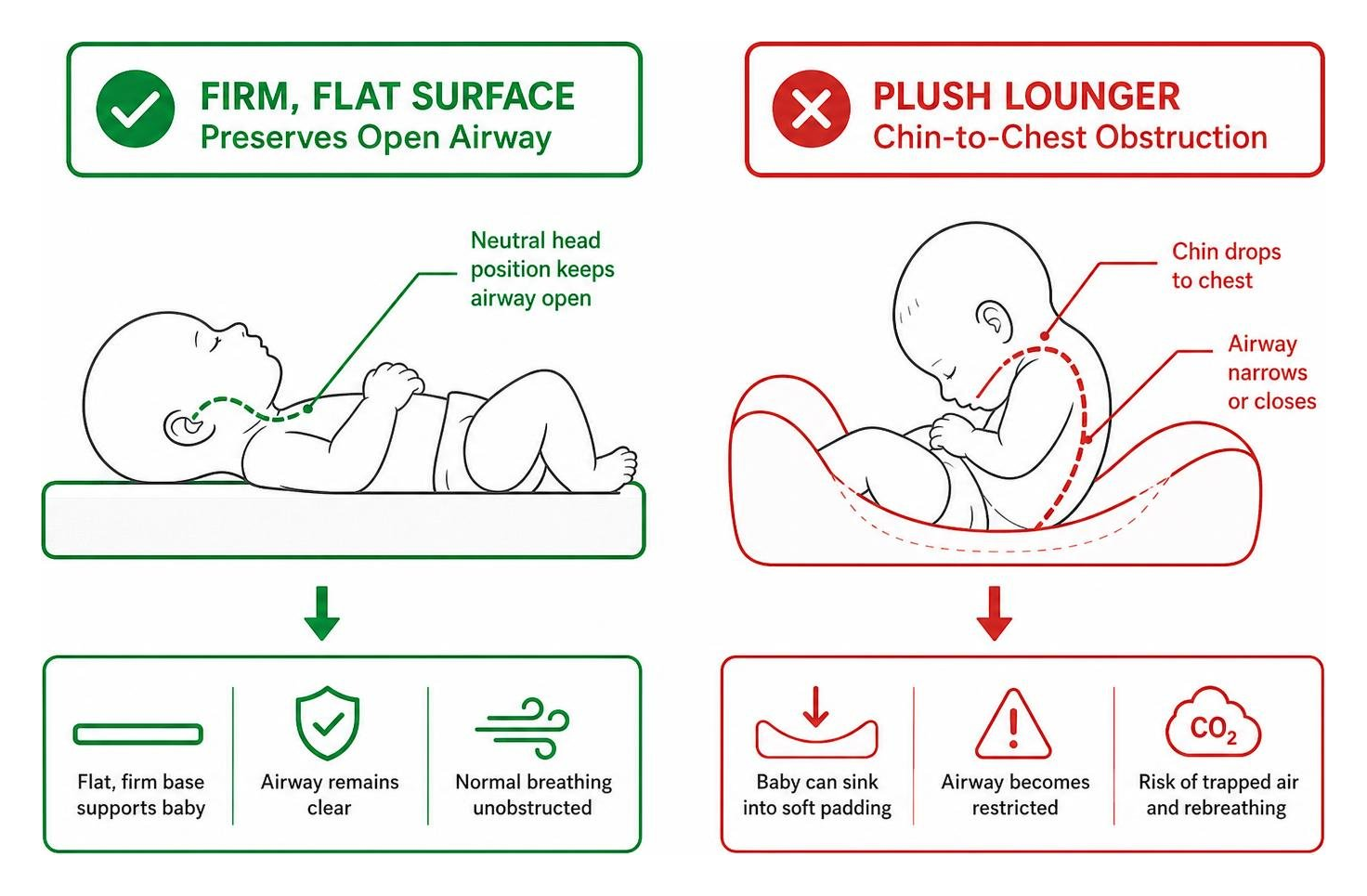
When selecting a lounger for newborn awake time, understanding the physics of infant positioning is essential for every expecting or new parent, grandparent, caregiver, and thoughtful gift shopper choosing safe, comfortable, high-quality baby essentials. A newborn's head is disproportionately heavy relative to their body mass, and their delicate neck muscles are not yet fully developed. In soft, inclined, or overly plush environments, a baby can easily roll face-down into padded side walls or slump forward into an unnatural posture.
When a baby's chin drops toward their chest (a condition known as positional asphyxiation), their narrow airway can become constricted without making a sound or causing obvious distress. Furthermore, soft, plush padding creates a confined environment where exhaled air becomes trapped, leading to dangerous carbon dioxide rebreathing.
To protect infants, federal standards enforced by the U.S. Consumer Product Safety Commission (CPSC) updated consumer safety rules. Under the mandatory federal safety standard 16 CFR Part 1243 (effective in mid-2025), all infant support cushions and loungers must meet strict design and structural criteria:
- Firmness Requirements: Surfaces must be firm enough to prevent the baby's face from sinking into the fabric or mattress pad under any circumstance.
- Lower Side Profiles: High, pillow-like side bumpers are prohibited to dramatically reduce suffocation hazards if a baby rolls or turns sideways.
- Flat, Recessed Foundations: Design rules mandate stable, flat bases that prevent slumping or chin-to-chest flexion.
- Prominent Permanent Warnings: Explicit, clear labels must state that the item is strictly for awake, supervised use and never for sleep.
Identifying Compliant Design vs. Unsafe Lounger for Newborn Features
Identifying a safe, compliant support product requires evaluating structural design rather than relying on soft textures or aesthetic claims.
When shopping for a safest infant lounger, look for:
- A flat, firm center surface with low-profile perimeter sides designed for proper physical alignment.
- Permanent tracking labels detailing the manufacture date, batch number, and CPSC compliance status.
- Uncompromising non-inclined geometry without dangerous wedges or elevation inserts.
- Certification of non-toxic, chemical-free textiles, such as OEKO-TEX certified cotton or linen covers, which ensure soft, safe materials for delicate newborn skin.
In contrast, non-compliant or older products often feature deep plush inclines, high cushioned pillow walls, and lack permanent tracking labels or safety warnings.
Safe Awake-Time Guidelines for Every Lounger for Newborn
Even fully compliant support cushions require strict usage guidelines to protect your baby's safety and healthy physical development:
- Continuous Visual Supervision: Never leave a baby unattended in a lounger, even for a brief moment.
- Floor-Only Placement: Always place the lounger on a low, flat floor. Never set it on couches, beds, tables, or counter spaces where sudden movement could lead to dangerous falls.
- Strict Awake-Time Limits: Pediatric experts recommend limiting time spent in restricted support seats ("containers") to 15-20 minutes per session, no more than twice daily.
- Prioritize Free Floor Tummy Time: Prolonged time in soft support seats can contribute to positional plagiocephaly (flat head syndrome) and container baby syndrome, delaying key motor milestones. Transitioning your awake newborn to a flat, firm floor mat or an organic newborn lounger cushion for supervised tummy time builds essential neck, shoulder, and core strength.
Why Unsafe Unregulated Loungers Persist Online and How to Avoid Them
Despite clear federal regulations, dangerous and non-compliant infant loungers remain available in the marketplace, particularly on unvetted online sales platforms. Regulatory bodies actively monitor e-commerce platforms, removing tens of thousands of illicit listings each year. Between 2025 and early 2026 alone, federal agencies facilitated the removal of over 106,000 non-compliant product listings from third-party online sellers.
Unsafe products continue to circulate due to direct-to-consumer overseas manufacturers who re-list recalled or banned items under new seller names faster than enforcement agencies can flag them. Additionally, legacy inventory manufactured prior to May 2025 continues to circulate legally on secondhand markets, in local buy-sell-trade groups, and at garage sales.
To safeguard your nursery and protect your newborn:
- Check official government recall databases before purchasing or accepting secondhand baby items.
- Avoid third-party marketplace listings that lack clear brand traceability, verifiable contact details, or physical manufacturer addresses.
- Explore expert guidance in our baby lounger ultimate guide 2026 to make informed, safe purchasing choices for your family.
Misleading Marketing Terms to Watch Out For
Exhausted parents searching for sleep solutions are particularly vulnerable to persuasive, emotionally targeted advertising phrasing. Be cautious of marketing terms that skirt safety regulations while implying safe sleep:
- "Snuggle Womb Nest" or "Sleep Support Cushion"
- "Co-Sleeper Insert for Adult Bed"
- "Anti-Reflux Incline Pillow" (If your baby suffers from reflux, consult a pediatrician. Placing an infant on an uncertified incline pillow increases airway obstruction risks; learn more in our guide on choosing a lounger for baby with reflux).
Regardless of soft fabrics, luxury claims, or comforting product names, no lounger cushion is certified for safe, unsupervised infant sleep.
Safe Sleep Best Practices: The ABCs vs. Daytime Lounging
To keep infants safe during sleep, leading health organizations such as the American Academy of Pediatrics (AAP) emphasize the ABCs of Safe Sleep:
- A - Alone: The sleep space should contain only the infant. No loose blankets, pillows, bumper pads, stuffed animals, or lounger cushions should ever be present in the crib or bassinet.
- B - Back: Always place your baby to sleep on their back for every nap and nighttime sleep routine to maintain an open, unobstructed airway.
- C - Crib: The baby must sleep in a certified crib, bassinet, or play yard equipped with a firm, flat mattress and a tight fitted sheet.
If your baby drifts off while resting in a support cushion during awake time, transfer them immediately to a bare, firm safe sleep space. Learn more about creating secure, healthy environments in our article on safe sleep lounger guidelines.
| Feature | Supervised Awake Lounger / Cushion | Certified Safe Sleep Bassinet / Crib |
|---|---|---|
| Primary Purpose | Awake time, resting, tummy time, bonding | Unsupervised nighttime sleep and naps |
| Surface Firmness | Firm base with soft outer fabric | Rigid, firm, completely flat mattress |
| Side Construction | Low padded perimeter sides | Breathable mesh walls or standard slats |
| Adult Supervision | Continuous, direct visual observation | Periodic monitoring ( overnight sleep) |
| Bedding / Accessories | Removable, washable cotton covers | Tight fitted sheet only; no plush items |
Safe Daytime and Sleep Alternatives for Newborns

When selecting baby gear, families do not need to choose between elegance, practicality, and safety. There are safe options available for both daytime lounging and sleep routines:
- For Daytime Awake Lounging & Tummy Time: Choose handcrafted baby nests or support cushions made with 100% natural, chemical-free materials. Look for OEKO-TEX certified cottons and breathable fillings that provide firm support on the living room floor while keeping your baby comfortable.
- For Sleep and Portable Napping: Opt for a traditional, handcrafted Moses basket equipped with a firm, flat mattress pad, or a certified bedside bassinet with full mesh sides. An eco-friendly Moses basket provides a lightweight, beautifully styled, safe option that transitions seamlessly from room to room.
If you are evaluating portable options, explore our complete breakdown on selecting a portable infant lounger bassinet for your lifestyle.
Frequently Asked Questions About Infant Loungers
What should I do if my baby falls asleep in a lounger?
Transfer your baby immediately to a safe sleep surface, such as a crib, bassinet, or play yard with a firm, flat mattress and a tightly fitted sheet. Do not leave the baby in the lounger, even if you remain in the room.
How do I safely dispose of a recalled or non-compliant lounger?
To prevent a non-compliant or recalled item from being reused, unzip the outer cover, remove the inner cushion, and use shears to cut the cover, foam base, and side bumpers into small pieces before placing them in the trash or textile recycling.
Are baby loungers safe to place inside a bassinet or adult bed?
No. Never place a lounger cushion inside a bassinet, crib, play yard, or adult bed. Adding a cushion to an enclosed sleep space creates suffocation hazards and soft side-trap risks. Read our detailed guide on the risks of placing a lounger in bassinet setups.
Conclusion
Navigating newborn essentials should bring joy, confidence, and peace of mind. By understanding current safety standards, avoiding misleading marketing terms, and distinguishing between supervised awake time and safe sleep environments, you can make safe, informed choices for your growing family.
At CocoMi Boutique, we design beautiful, practical baby essentials rooted in safety, luxury, natural craftsmanship, and European-quality standards. Founded by parents who sought elegant, non-toxic alternatives for their own nursery, our collection features handcrafted Moses baskets, organic baby nests, soft muslin swaddles, and chemical-free bedding certified to OEKO-TEX safety standards. Whether you are shopping online or visiting our boutique near Chicago, IL, we are here to support your family's journey with premium materials, thoughtful design, and safe products for delicate newborn skin.
Explore CocoMi's safe newborn collection to find handcrafted, eco-friendly essentials designed with your baby's safety and comfort in mind.