

Why Putting a Lounger in a Bassinet Is Never Safe — And What to Do Instead

Placing a lounger in a bassinet is one of the most common — and dangerous — mistakes new parents make. Here is the short answer:
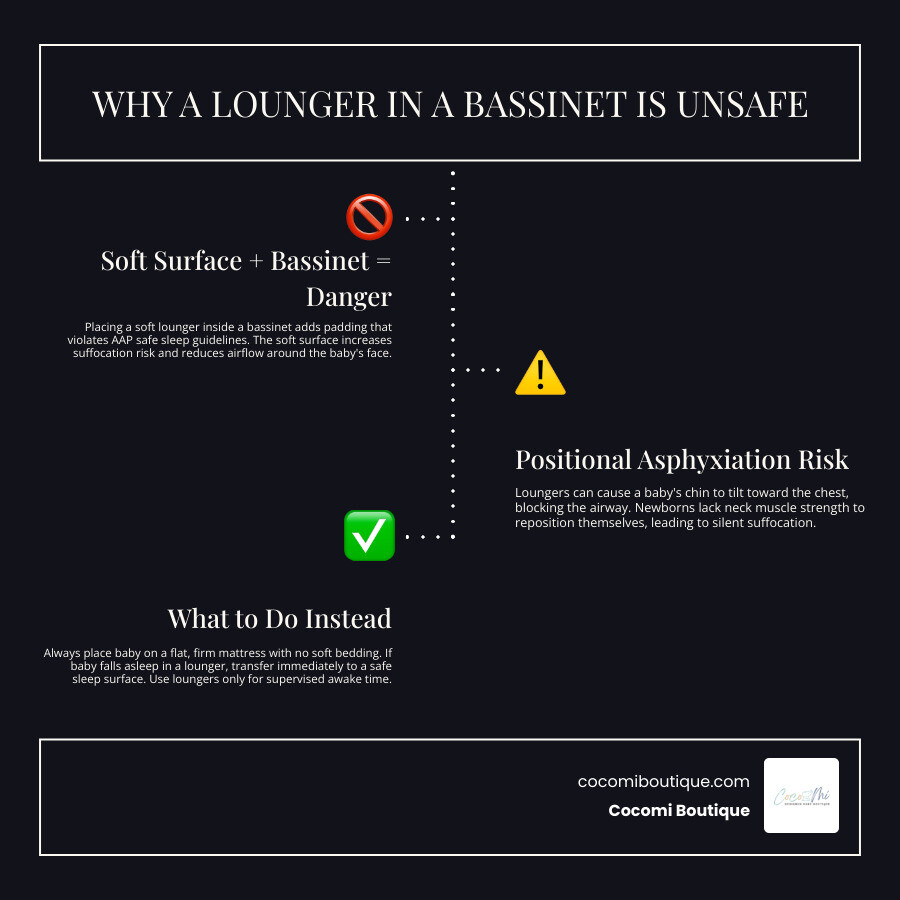
Never place an infant lounger inside a bassinet, crib, or on an adult bed. It violates safe sleep guidelines and significantly increases the risk of suffocation and positional asphyxiation.
Quick facts:
- Infant loungers (soft, padded nests) are not approved for unsupervised sleep
- The American Academy of Pediatrics (AAP) recommends babies sleep on a flat, firm surface with no soft bedding or padding
- A lounger placed inside a bassinet adds dangerous softness and reduces airflow — even in an otherwise safe sleep space
- If your baby falls asleep in a lounger, move them to a flat, firm surface immediately
- Loungers are safe only for supervised awake time, such as tummy time or diaper changes
Many parents turn to loungers out of exhaustion or because their baby has reflux and fights a flat surface. That struggle is real — and this article addresses it directly. But the risks of using a lounger for sleep are serious, and understanding why matters.
I'm Monika Jarog, founder of Cocomi Boutique, where I design handcrafted baby nests and Moses baskets from 100% natural, OEKO-TEX certified materials — so the question of what makes a lounger in a bassinet setup unsafe versus what makes a properly designed baby nest genuinely safe is something I think about every day. Let's walk through exactly what the research says, and what safer options look like for your baby.
Explore more about lounger in bassinet:
The Hidden Dangers of Placing an Infant Lounger in Bassinet Spaces
When you look at a beautifully designed infant lounger, it is easy to see why it appeals to tired parents. It looks like a cozy, cloud-like sanctuary. However, putting a lounger in a bassinet environment completely overrides the safety engineering of the bassinet itself.
Bassinets are highly regulated products. In the United States, they must comply with strict federal safety standards set by the Consumer Product Safety Commission (CPSC), specifically 16 CFR part 1218, as well as ASTM F2194 standards. These regulations dictate that a baby's sleep surface must be firm, flat, and surrounded by breathable, tense barriers. For more details, you can review the official CPSC safety standards on infant sleep products.
When you place a soft, pillowy infant lounger on top of a firm bassinet mattress, you introduce a soft, plush, and unregulated micro-environment. The soft sides of the lounger can easily mold around a newborn’s delicate face if they roll or turn their head, creating an immediate suffocation hazard. Furthermore, because a lounger is not structurally anchored to the bassinet, it can shift, tilt, or trap a baby between the soft edge of the lounger and the mesh or wooden side of the bassinet. To learn more about choosing a safe sleep setup, read our guide on the safe sleep lounger.
Why a Soft Lounger in Bassinet Environments Restricts Airflow
The physics of infant breathing are incredibly delicate. Newborns do not have the lung capacity or the developmental reflexes of older children. When a baby is placed inside a soft, padded lounger, their face is positioned in close proximity to thick, plush fabric barriers.
As a baby exhales, they release carbon dioxide ($CO2$). In a standard, safe sleep space with a flat mattress and mesh walls, this $CO2$ quickly dissipates into the surrounding room. However, when a baby is nestled deep within a padded lounger, the heavy, soft sides trap the exhaled air. This creates a pocket of concentrated carbon dioxide.
The baby then breathes this stale air back in—a phenomenon known as $CO_2$ rebreathing. Over time, rebreathing carbon dioxide deprives the baby’s brain and organs of vital oxygen, leading to hypoxia and, in worst-case scenarios, sudden infant death. To understand more about how these fabrics behave and how to keep your baby safe, read our guide on the truth about newborn snuggle nests safety benefits and what to consider.
The Risk of Positional Asphyxiation with a Lounger in Bassinet Sleep Setups
Perhaps the most insidious danger of using a lounger in a bassinet is positional asphyxiation. Unlike suffocation, which occurs when an external object physically blocks the nose and mouth, positional asphyxiation occurs because of the baby's body position.
Newborns have very heavy heads and incredibly weak neck muscles. If they are placed on an incline or on a soft, contoured surface that allows their head to tilt forward, their chin can easily press down against their chest.
Because a newborn's airway (trachea) is about the width of a drinking straw and highly flexible, this chin-to-chest position physically kinks the airway shut. The baby cannot breathe, yet because they are asleep and lack the developmental reflexes to lift or turn their head, they will not wake up or struggle. It is a silent, rapid, and entirely preventable tragedy. The AAP clinical report on safe infant sleep emphasizes that only a completely flat, non-contoured surface keeps a newborn’s airway naturally open and safe.
Why Exhausted Parents Turn to Loungers (And the Reflux Dilemma)
We understand why parents do this. No one sets out to create an unsafe sleep environment. Instead, most parents who place a lounger in a bassinet do so out of sheer, bone-deep exhaustion.
Consider a common real-world scenario: Baby Leo is two months old. He has severe Gastroesophageal Reflux Disease (GERD). Every time his parents lay him flat on his back on his firm bassinet mattress, he wakes up within ten minutes screaming, coughing, and choking on his reflux. Desperate for sleep and terrified of their baby choking, his parents place a soft, slightly contoured lounger inside the bassinet. Suddenly, Leo sleeps for four hours straight. His parents finally get some rest, unaware that the very product keeping Leo quiet is putting his life at risk.
This reflux dilemma is incredibly common. Infant reflux typically peaks between 2 and 4 months of age. Because the lower esophageal sphincter is still maturing, stomach contents easily flow back up into the esophagus, causing painful burning. When laid flat, gravity no longer helps keep stomach acid down, leading to frequent night wakings.
Additionally, the transition from a warm, cozy hold in a parent's arms to a cold, flat, expansive bassinet mattress often triggers the startle reflex (Moro reflex), instantly waking the baby. For more context on why your newborn resists the flat mattress and how to unlock better sleep, check out our guide on beyond the bassinet unlocking your newborns sleep comfort secrets.
Safe Alternatives for Babies with Reflux
If your baby is struggling with severe reflux or GERD, you do not have to choose between sleep and safety. There are pediatrician-approved, safe strategies to manage reflux symptoms without resorting to putting a lounger in a bassinet:
- Hold Upright Post-Feed: Keep your baby completely upright against your chest or shoulder for at least 15 to 30 minutes after every single feeding. This allows gravity to assist with digestion and significantly reduces the volume of spit-up when they are eventually laid down.
- Pre-Warm the Mattress: The sudden drop in temperature from your warm body to a cold bassinet mattress often wakes a sensitive baby. Before placing your baby down, place a warm heating pad or a warm water bottle on the bassinet mattress for a few minutes. Crucial safety step: Always remove the heating pad or water bottle and check the mattress with your hand to ensure it is comfortably warm—never hot—before laying your baby down.
- Scent Transfer: Newborns rely heavily on their sense of smell. Sleep with your baby’s fitted bassinet sheet or wearable sleep sack for a night or two before putting it on their bed. Having your familiar, calming scent close by helps soothe them as they transition to their flat sleep surface.
- Consult Your Pediatrician: If reflux is severely impacting your baby's sleep and growth, consult your pediatrician. They can evaluate whether medical interventions, specialized feeding techniques, or safe sleep positioners are appropriate. To explore how to navigate these choices safely, read our article on crib or nest navigating safe sleep for your baby.
For more tailored insights on managing reflux safely, you can also explore our specialized article on choosing a lounger for baby with reflux.
Bassinets vs. Loungers: A Safety Comparison
To help clarify why these two products must never be combined, let's look at how they compare structurally and legally:
| Feature | Safe Bassinet | Unsafe Lounger (For Sleep) |
|---|---|---|
| Primary Purpose | Unsupervised infant sleep (0–6 months) | Supervised awake time, lounging, tummy time |
| Surface Firmness | Rigid, flat, and firm (does not indent under baby's weight) | Soft, plush, and contoured (conforms to baby's body) |
| Side Barriers | Tense, breathable mesh or rigid wooden rails | Thick, padded, pillowy fabric borders |
| Airflow Design | Engineered for maximum ventilation and $CO_2$ dispersal | Designed for warmth and cradling, which traps air |
| CPSC Regulations | Complies with strict federal safety standards (16 CFR 1218) | Exempt from infant sleep standards; not rated for sleep |
| JPMA Certification | Available and highly recommended | Not certified for unsupervised sleep environments |
Combining these two items by placing a lounger in a bassinet creates a hybrid environment that possesses none of the safety benefits of a bassinet and all of the structural hazards of a soft sleep surface. If you are looking for a highly portable, safe sleeping setup that meets strict standards, read our guide on choosing a portable infant lounger bassinet.
How to Safely Transition Your Baby to a Flat Bassinet Mattress
If your baby has become accustomed to sleeping in a lounger or in your arms, transitioning them to a flat, firm bassinet mattress can take a bit of patience. However, with a consistent approach, most babies adapt beautifully within a week or two.

- Step 1: Start with Daytime Naps: It is often easier to introduce a new sleep surface during the day when you are alert and less exhausted. Place your baby in their flat bassinet for their first nap of the day, when their sleep drive is highest.
- Step 2: Use the "Drowsy but Awake" Method: Lay your baby down when they are heavy-eyed and relaxed, but not completely asleep. This helps them learn that the bassinet is a safe, comfortable place to fall asleep independently, rather than waking up startled in a different place than where they drifted off.
- Step 3: The Feet-First Transfer: When transferring a sleeping baby to their bassinet, lower them slowly and horizontally. Let their feet touch the mattress first, then their bottom, and finally their shoulders and head. This gradual contact minimizes the sensation of falling, which triggers the startle reflex.
- Step 4: Keep the Environment Consistent: Use a consistent white noise machine to drown out household sounds and keep the room dark and cool (ideally between 68°F and 72°F).
- Step 5: Practice Room-Sharing: The AAP recommends room-sharing (but not bed-sharing) for at least the first six months of life. Having your baby's bassinet right next to your bed allows you to easily hear, soothe, and monitor them without needing to resort to unsafe sleep setups.
For a deeper dive into making this transition as smooth as possible, read our comprehensive guide on nest or no nest decoding safe sleep for your newborn.
Frequently Asked Questions About Safe Sleep
What should I do if my baby falls asleep in an infant lounger?
If your baby falls asleep in an infant lounger, you must immediately transfer them to a safe, flat sleep space, such as their bassinet or crib. Even if you are sitting right next to them and watching them sleep, positional asphyxiation can happen silently and without warning. Loungers should strictly be reserved for supervised awake time—such as tummy time, quick diaper changes, or active, awake family interaction on the floor.
Are there any bassinets designed specifically for babies with reflux?
Under current safety standards, all approved bassinets must feature a flat, firm sleeping surface. There are no approved bassinets that allow a baby to sleep on a permanent incline, as any incline greater than 10 degrees significantly increases the risk of positional asphyxiation. If your baby has severe reflux, work closely with your pediatrician to manage their symptoms through upright feeding practices, pacing, and medical guidance rather than using unapproved inclined sleep products.
Can I use a baby nest for supervised tummy time?
Yes! High-quality, breathable baby nests are fantastic tools for supervised awake play and tummy time. Placing a baby nest on the floor provides a comfortable, clean, and defined space for your baby to practice lifting their head, strengthening their neck, and developing their motor skills. Just remember: a parent or caregiver must maintain constant visual supervision the entire time the baby is using the nest, and the nest must never be used for sleep.
Conclusion
At CocoMi Baby Boutique, we understand that parenting is a journey filled with deep love, occasional exhaustion, and endless decisions. Our mission is to support you with beautiful, handcrafted baby essentials that never force you to choose between elegant style and safety.
Every single baby nest, Moses basket, and blanket in our collection is thoughtfully handcrafted from 100% natural, chemical-free, and OEKO-TEX certified organic materials. We design our products to meet the highest safety standards, ensuring your peace of mind while protecting your baby's sensitive skin.
While infant loungers and nests are wonderful, invaluable tools for supervised awake play, tummy time, and family bonding, they must never be used for unsupervised sleep or placed inside a bassinet. By keeping your baby's sleep environment flat, firm, and completely clear of soft padding, you are giving them the safest possible start in life.
Explore CocoMi Boutique's safe sleep solutions today to discover premium, handcrafted essentials designed by parents, for parents.