

Why the Types of Swaddle Blankets You Choose Matter More Than You Think

The types of swaddle blankets available to new parents today range from simple square muslin wraps to structured zip-up sacks — and picking the right one can genuinely change how well both you and your baby sleep.
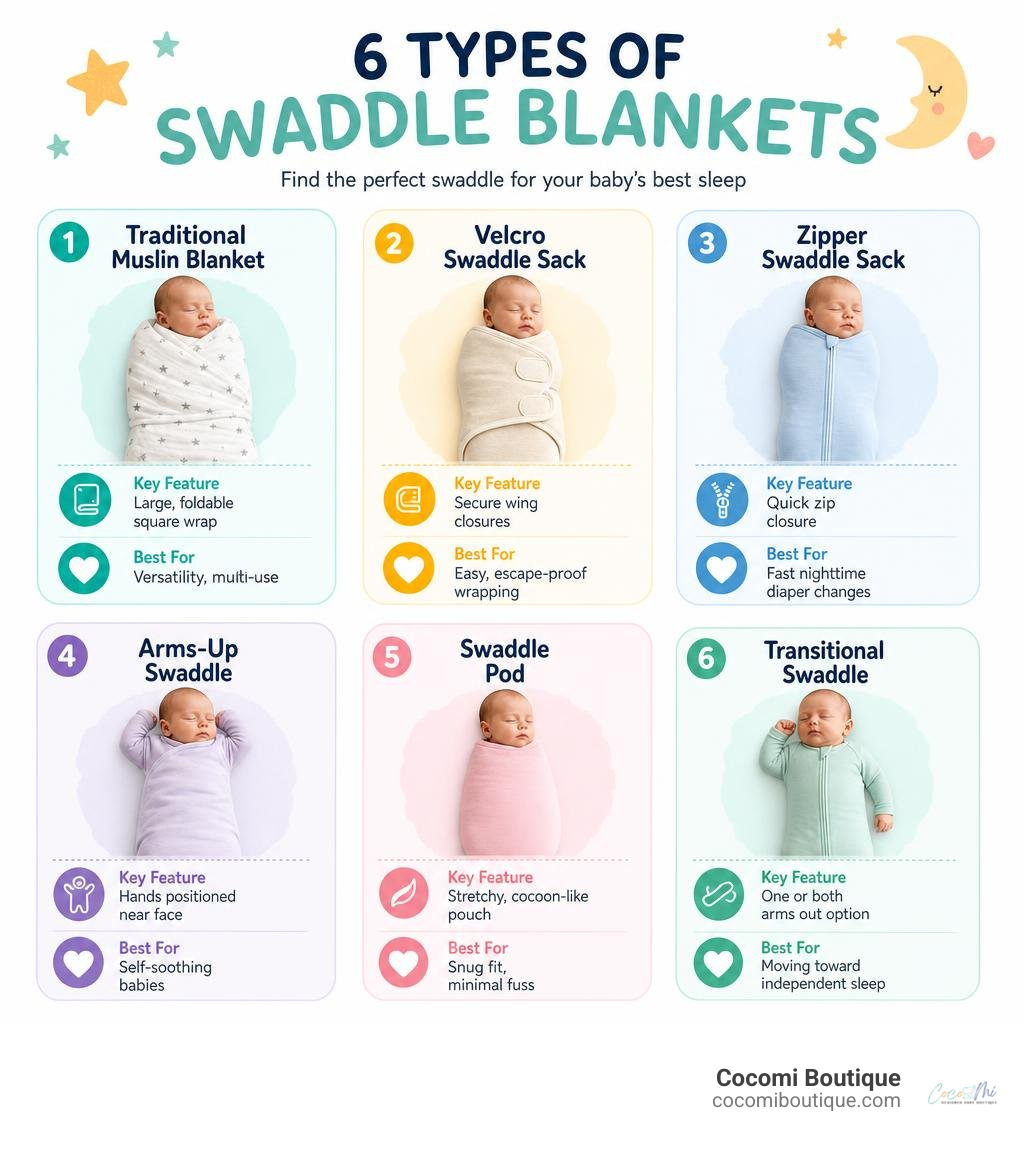
Here is a quick overview of the main types:
| Type | Key Feature | Best For |
|---|---|---|
| Traditional muslin blanket | Large, foldable square wrap | Versatility, multi-use |
| Velcro swaddle sack | Secure wing closures | Easy, escape-proof wrapping |
| Zipper swaddle sack | Quick zip closure | Fast nighttime diaper changes |
| Arms-up swaddle | Hands positioned near face | Self-soothing babies |
| Swaddle pod | Stretchy, cocoon-like pouch | Snug fit, minimal fuss |
| Transitional swaddle | One or both arms out option | Moving toward independent sleep |
Most newborns are comforted by being swaddled because it recreates the snug, contained feeling of the womb. It also helps suppress the Moro reflex — the involuntary startle response that can jolt a sleeping baby awake without warning. The result? Longer, calmer sleep for your little one, and more rest for you.
But with so many styles on shelves and registries, it is easy to feel overwhelmed before your baby even arrives.
That is exactly what this guide is here to solve.
I'm Monika Jarog, and through my work crafting handcrafted baby essentials at Cocomi Boutique — including our premium natural muslin swaddles — I've developed a deep understanding of how the different types of swaddle blankets affect a newborn's comfort, safety, and sleep quality. Let's walk through everything you need to know, clearly and simply.
Types of swaddle blankets further reading:
The Main Types of Swaddle Blankets for Newborns
When you are preparing your nursery in Northbrook, IL, or building your ultimate baby registry checklist, navigating newborn sleep gear can feel like learning a new language. The variety of types of swaddle blankets can be divided into two primary categories: traditional square blankets and structured wearable swaddle sacks.
Choosing the right style is not just about aesthetics; it is about matching your baby's unique sleep temperament with high-quality, safe materials.

Every baby has a distinct personality from day one. Some newborns love being wrapped up like a tight little burrito, while others wiggle and fight to free their hands. Finding the perfect fit requires understanding the design, function, and benefits of each swaddle type.
Traditional Muslin Types of Swaddle Blankets
The traditional muslin swaddle blanket is the undisputed classic of the nursery. Typically measuring between 42x42 and 47x47 inches, these large, lightweight squares of fabric rely entirely on the art of folding to secure your little one.
The magic of a traditional wrap lies in its unmatched versatility. Because there are no fixed zippers, snaps, or Velcro straps, you can customize the wrap to your baby’s exact shape and size every single night. If your baby prefers their hips a bit looser or needs one arm tucked slightly differently, a traditional blanket adapts beautifully.
Beyond helping your newborn achieve restful sleep, these blankets serve multiple purposes throughout the day. A premium muslin blanket can easily transition into:
- A lightweight stroller cover to block out bright sunlight during walks through Glencoe or Winnetka.
- A soft, breathable nursing shield for on-the-go feedings.
- A clean, quick changing mat cover or a gentle playmat for spontaneous tummy time.
- A cozy burp cloth to handle unexpected messes.
At Cocomi Boutique, we believe in the beauty of handcrafted, premium quality. Our traditional wraps are made from exceptionally soft, chemical-free, and organic materials that get softer with every single wash. For a deep dive into the luxury of organic options, explore our guide on Organic Cotton Swaddle Blankets: A Guide to the Softest Snuggles.
If you are a first-time parent, mastering the fold might feel like a 3 a.m. origami puzzle. But with a little practice, it quickly becomes second nature. To learn the exact steps, check out our tutorial on Mastering the Muslin Swaddle: How to Wrap Your Baby for Sweet Dreams and find more helpful tips in The Ultimate Guide to Choosing the Perfect Muslin Swaddle Blanket for Your Baby.
Modern Zipper and Velcro Swaddles
For parents who want a foolproof, quick-wrapping solution, modern structured swaddles are a lifesaver. These "two-in-one" wearable swaddles utilize secure Velcro wings or smooth, dual-direction zippers to keep your baby snugly contained without the need for complex folding.
Velcro swaddle sacks feature a pocket for your baby's legs and wide, adjustable fabric wings that wrap tightly around the chest. The strong hook-and-loop fasteners ensure that even the most active "Houdini" babies cannot break free and leave loose fabric in their crib.
Zipper swaddles simplify the process even further. You simply place your baby inside the pouch and pull up the zipper. Many of these designs feature two-way zippers, allowing you to unzip the bottom half for quick, middle-of-the-night diaper changes while keeping your baby’s arms snugly secured and warm up top.
While these structured fasteners offer incredible ease of use, they do have a few minor drawbacks compared to traditional muslin. The sound of ripping Velcro can occasionally startle a light sleeper during diaper changes, and structured swaddles cannot be repurposed as stroller covers or nursing shields once your baby outgrows them. Additionally, you must be careful to fasten all Velcro wings before throwing them in the washing machine to prevent snagging other delicate garments.
If you are looking for a reliable, structured option, you can learn more about how they compare in our review of The Best Baby Swaddle Blanket Options for a Peaceful Night's Sleep.
Arms-Up Swaddles and Swaddle Pods
Some newborns absolutely detest having their arms pinned directly to their sides. If your baby constantly fights to bring their hands to their mouth, they may benefit from an arms-up swaddle or a swaddle pod.
These innovative designs are crafted from highly stretchy, elastic fabrics that fit snugly around the baby's torso while allowing their arms to rest in a natural, upright position near their face. This "arms-up" posture supports healthy self-soothing, as babies can gently rub their cheeks or suck on their hands to calm themselves back to sleep.
Swaddle pods are ultra-simple, cocoon-like pouches that zip straight up the front. They provide a comforting, close-fitting hug that mimics the physical boundaries of the womb while still allowing natural movement of the elbows and knees. Because the fabric is highly elastic, it stretches as your baby wiggles, mitigating the startle reflex without completely immobilizing their limbs.
These specialized swaddles are fantastic for active sleepers and serve as an excellent bridge when you eventually begin transitioning your baby away from snug, full-body wraps.
Choosing the Right Fabric: Breathability, Comfort, and Safety
The fabric you choose for your baby's swaddle is just as important as the design. A newborn's skin is incredibly thin, delicate, and sensitive to synthetic chemicals, dyes, and rough textures. Furthermore, during the first few months of life, infants cannot effectively regulate their own body temperature, making high-quality, breathable fabrics a non-negotiable safety requirement.

When selecting swaddles, we always recommend prioritizing natural, organic fibers with OEKO-TEX certifications. This ensures that the fabric touching your baby’s skin is entirely free from harmful chemical residues, pesticides, and flame retardants.
Organic Cotton vs. Bamboo Muslin
Two of the finest natural materials for swaddling are organic cotton and bamboo viscose. Both offer exceptional benefits, but they feel and perform slightly differently:
- Organic Cotton Muslin: This is the traditional standard for high-quality baby bedding. Cotton muslin is incredibly durable, highly breathable, and remarkably resilient. It features a unique open-weave pattern that allows air to flow freely, keeping your baby comfortable. One of the most charming characteristics of organic cotton muslin is that it actually gets softer, loftier, and more textured with every single wash.
- Bamboo Viscose: Bamboo fabric is the "Goldilocks" of baby apparel. It is extraordinarily silky, cool to the touch, and boasts a luxurious drape. Bamboo is naturally hypoallergenic, moisture-wicking, and possesses natural antibacterial properties. It also offers a beautiful, gentle stretch, making it ideal for a snug yet comfortable wrap.
For a detailed comparison of these two premium materials to help you decide which is perfect for your family, take a look at our comprehensive guide on Bamboo or Cotton: Your Guide to the Best Organic Muslin Swaddles. You can also explore our Organic Swaddle Blankets Complete Guide to learn more about our commitment to pure, safe materials.
Thermal Overall Grade (TOG) and Temperature Regulation
To keep your baby safe and comfortable throughout the changing seasons in Illinois—from chilly winters in Deerfield to warm, humid summer nights in Chicago—it is essential to understand TOG ratings.
TOG stands for Thermal Overall Grade, and it measures the thermal resistance or insulating properties of a fabric. The higher the TOG rating, the warmer and more insulated the swaddle will be. Here is a general guide for matching TOG ratings with your nursery's temperature:
- 0.5 TOG: Lightweight and highly breathable. Ideal for warm summer months (74°F to 78°F) or for layering over a long-sleeve bodysuit in a temperate room.
- 1.0 TOG: Moderate weight. Perfect for year-round use in standard nursery temperatures (68°F to 72°F).
- 2.5 TOG: Heavily insulated and warm. Best suited for cold winter nights (61°F to 67°F) when the nursery is cool.
To prevent the risk of overheating—which is a known risk factor for SIDS—always monitor your baby's physical cues. Check the back of their neck or their chest; if their skin feels hot, sweaty, or flushed, they are dressed too warmly.
For expert advice on managing sleep comfort during the hotter months, read our seasonal guide on Summer Swaddling Secrets: How to Keep Your Little One Cool and Content.
Safe Swaddling Practices and Transitioning Milestones
Swaddling is a wonderful tool for soothing newborns, but it must always be practiced with safety at the forefront. Following the American Academy of Pediatrics (AAP) guidelines ensures that your baby remains safe, healthy, and secure during every nap and nighttime sleep.
The three non-negotiable rules of safe swaddling are:
- Always place your baby on their back to sleep: Never place a swaddled baby on their stomach or side, as this significantly increases the risk of suffocation.
- Ensure the sleep space is completely clear: There should be no loose blankets, pillows, bumper pads, stuffed animals, or toys in the crib or bassinet. The swaddle must fit snugly so that it cannot ride up over your baby's nose or mouth.
- Keep the wrap snug but not too tight: You should be able to comfortably slide two to three fingers between the swaddle fabric and your baby's chest.
For an exhaustive review of safe sleep habits, consult The Ultimate Guide to Safe Swaddling for Newborns.
Hip Health and Preventing Dysplasia
Proper hip positioning is one of the most frequently overlooked aspects of safe swaddling. Hip dysplasia—a condition where the hip joint does not develop properly—occurs in about one in ten infants after birth. Tight, restrictive swaddling that forces a baby’s legs straight down and binds their knees together can severely aggravate or even cause hip dysplasia.
To ensure your swaddle is certified hip-healthy, always allow your baby’s legs to bend naturally up and out in a "frog-leg" or "M" position. The International Hip Dysplasia Institute emphasizes that the swaddle should be secure and snug around the arms and chest, but loose, roomy, and flexible from the hips downward. Your baby should have plenty of room to kick, bend their knees, and wiggle their hips freely.
When and How to Transition to Wearable Blankets
Swaddling is strictly a newborn sleep solution. You must stop swaddling your baby as soon as they show the very first signs of attempting to roll over independently.
On average, babies begin rolling over between two to four months of age, but some active babies may attempt to roll as early as 6 to 8 weeks. Once a baby can roll onto their stomach, they must have their arms completely free to push themselves up and clear their airway. Sleeping swaddled on the stomach is an extreme safety hazard.
Other signs that it is time to transition include:
- Constantly breaking their arms out of the swaddle.
- Showing frustration or resisting being wrapped.
- Waking up in a completely different position in the crib than where they were placed.
To transition smoothly without causing a massive sleep regression, you can take a gradual approach:
- The One-Arm-Out Method: Swaddle your baby with one arm completely free for three to four nights, allowing them to adjust to the new freedom.
- Both-Arms-Out: Free the second arm, leaving only their chest wrapped snugly for security.
- The Sleep Sack: Graduate your baby into a standard, sleeveless wearable blanket (sleep sack) that keeps them warm safely without any loose bedding.
Frequently Asked Questions About Swaddling
As a premium boutique serving families across Chicago's North Shore—from Highland Park to Buffalo Grove—we hear many of the same questions from eager expecting parents. Here are our expert answers to help you navigate the journey.
How many swaddles do I need?
As a general rule of thumb, we recommend having a minimum of three swaddles on hand in your baby's current size. This "three-swaddle rule" ensures you are always prepared for the inevitable realities of life with a newborn:
- One in use: The swaddle your baby is currently wearing for sleep.
- One in the wash: To handle spit-up, diaper leaks, or middle-of-the-night blowouts.
- One clean and ready: Stashed in the nursery drawer, waiting for a quick change.
If you are using traditional muslin wraps, you may want to stock up on a few more (around 4 to 6), given their immense versatility as everyday stroller covers, burp cloths, and nursing shields.
What is the difference between a swaddle and a sleep sack?
While both are wearable sleep garments designed to keep babies warm safely, they serve entirely different developmental stages:
- Swaddles: Designed exclusively for the newborn stage (birth to around 2-4 months). They physically restrict arm movement to soothe the Moro reflex and mimic the tight containment of the womb.
- Sleep Sacks (Wearable Blankets): Designed for babies of all ages (from newborns up to toddlers). They are sleeveless, zip-up bags that keep the baby’s arms completely free while enclosing their legs to provide warmth without the safety hazards of loose blankets in the crib.
Can you swaddle a baby with arms out?
Yes, absolutely! Swaddling with the arms out is a fantastic option during the transition phase, or for active sleepers who simply refuse to have their arms bound but still crave the comforting, snug pressure of a wrap around their torso.
Using a versatile traditional muslin blanket is perfect for this, as you can easily secure the wrap snugly around your baby's chest and underarms, leaving both hands completely free to explore, self-soothe, and move safely.
Conclusion
Every baby’s sleep journey is unique, and finding the perfect option among the various types of swaddle blankets may take a small amount of patient experimentation. Whether you choose the timeless versatility of a traditional organic muslin wrap or the streamlined simplicity of a structured zipper sack, the key is prioritizing safe sleep practices, hip-healthy designs, and natural, chemical-free materials.
At Cocomi Boutique, we are dedicated to helping you create a peaceful, elegant, and safe nursery environment. Our carefully curated collection of premium, handcrafted baby essentials—including our buttery-soft organic cotton and bamboo muslin swaddles—is designed with your baby’s ultimate comfort and delicate skin in mind.
Ready to discover more parenting tips, safe sleep guides, and luxury nursery inspiration? Explore Cocomi Boutique's Journal today to find everything you need for your little one's sweet dreams.