

Why There Is No Such Thing as a Truly Safe Sleep Lounger

The idea of a safe sleep lounger is one of the most common — and most dangerous — misconceptions in the baby product world. No lounger, regardless of how it is marketed, meets the federal safety standards required for infant sleep. Yet millions of parents continue to use them for exactly that purpose, often without realising the risk.
Quick Answer: Is any baby lounger safe for sleep?
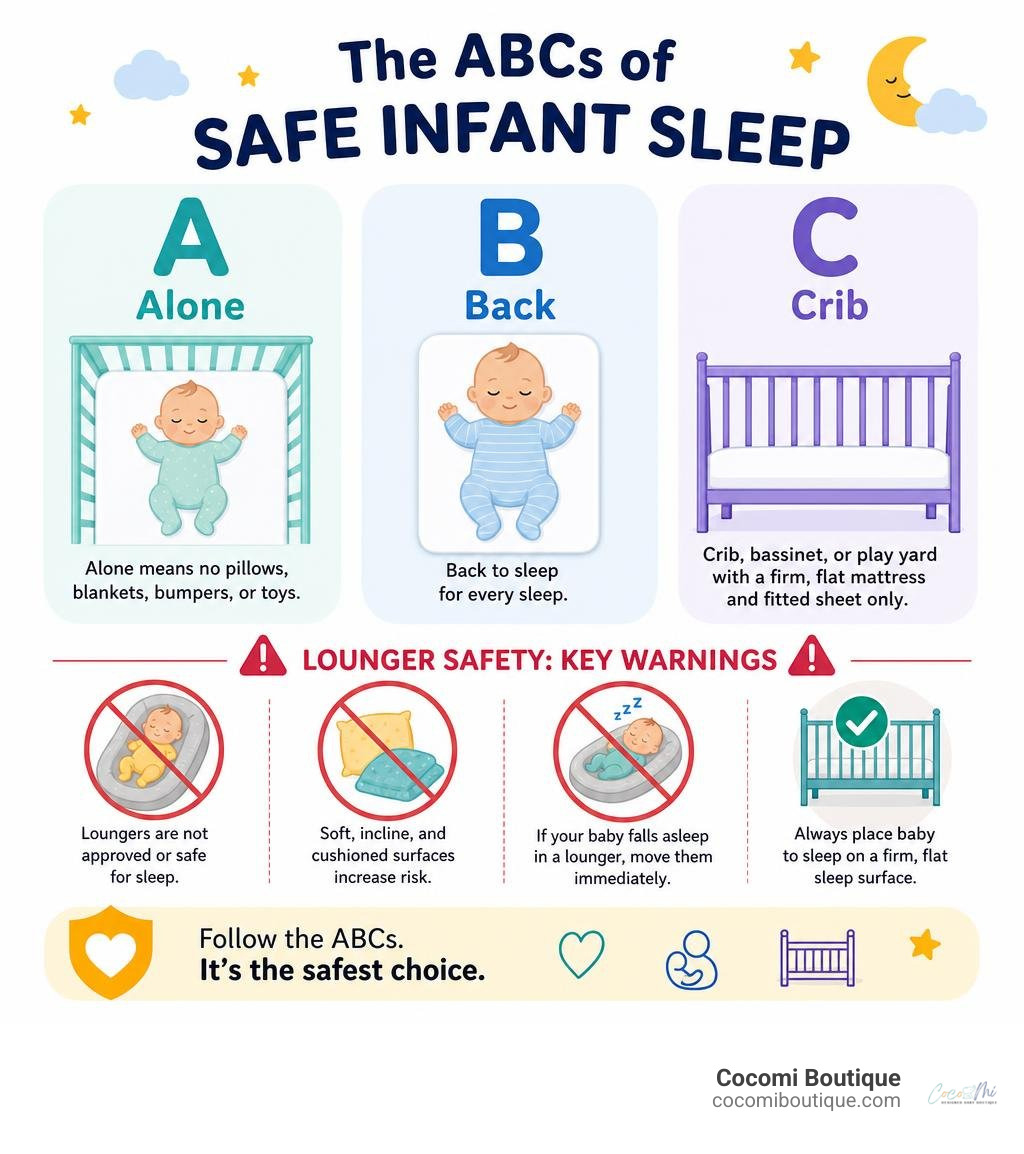
- No. No baby lounger is approved or safe for infant sleep — supervised or otherwise.
- Loungers are intended only for supervised awake time (tummy time, bonding, play).
- If your baby falls asleep in a lounger, move them immediately to a firm, flat crib, bassinet, or play yard.
- The only safe sleep surfaces meet CPSC standards: a crib, bassinet, or play yard with a firm, flat mattress and a fitted sheet only.
The stakes are real. Between 2025 and early 2026, four infant deaths linked to baby loungers were reported to the U.S. Consumer Product Safety Commission (CPSC). In February 2026 alone, one infant died in a baby lounger. These are not edge cases — they are the predictable result of a product being used in a way it was never designed to handle.
To an exhausted parent at 3 a.m., a soft, nest-like lounger can look like the answer to a desperate problem. That gap between how a product looks and what it is actually safe to do is exactly what this guide is here to close.
I'm Monika Jarog, founder of Cocomi Boutique, where I design handcrafted baby nests, Moses baskets, and nursery essentials made from 100% natural, chemical-free materials — and understanding the line between a safe sleep lounger myth and a genuinely safe sleep environment is something I care deeply about. In the sections ahead, we'll walk through the real hazards, the current regulations, and what you can actually do to keep your baby safe.
Explore more about safe sleep lounger:
The Myth of the Safe Sleep Lounger: Why They Do Not Exist
When we look at the beautifully curated nurseries of Chicago’s North Shore—from Winnetka and Glencoe to Highland Park and Deerfield—we often see plush, padded baby loungers taking center stage. They look incredibly comfortable, mimicking the sensation of being held. However, from a physiological and developmental standpoint, a safe sleep lounger is a physical impossibility.
The primary danger lies in the very design elements that make these products look so cozy: soft, pillowy surfaces and raised, cushioned sides. When an infant is placed on a soft, padded surface, several severe physiological risks immediately come into play:
- Positional Asphyxia: Unlike older children and adults, newborns have very weak neck muscles and heavy heads. If a baby's head slumps forward so that their chin touches their chest, their tiny airway can easily kink like a garden hose. This is known as positional asphyxia, and because it is silent, a sleeping baby can suffocate without making a sound or showing signs of struggle.
- Airway Obstruction: If a baby rolls over or turns their face even slightly to the side in a padded lounger, their nose and mouth can easily become pressed against the soft fabric or raised side bumpers, cutting off their oxygen supply.
- Suffocation: The plush padding itself poses a direct suffocation hazard. If the baby sinks into the material, the fabric can block their airway.
According to an extensive Infant Loungers Still Put Babies at Risk Despite Updated Safety Rules - Consumer Reports , these design features make loungers inherently dangerous for any unsupervised rest or sleep. The soft, contoured surfaces that feel so comforting to a parent's touch are the very elements that increase the risk of silent suffocation.
Why a "Safe Sleep Lounger" Violates CPSC Standards
To protect infants from these hidden hazards, federal regulatory bodies have established strict guidelines. Under the Consumer Product Safety Commission (CPSC) regulations, any product manufactured or marketed for infant sleep must meet rigorous safety requirements.
Specifically, the CPSC's Infant Sleep Products (ISP) rule (16 CFR Part 1236) and the safety standards for infant support cushions (16 CFR Part 1243) explicitly outlaw soft, inclined, or cushioned sleep surfaces.
According to the official CPSC Warns Consumers to Immediately Stop Using Baby Loungers Due to Suffocation Risk and Fall Hazard - Failure to Meet Federal Safety Regulation for Infant Sleep Products, products designed without rigid stands or those that feature soft, pillow-like bases fail to meet the federal safety criteria required for safe sleep.
Additionally, compliant children's products must feature clear tracking labels detailing the manufacture date, location, and batch information. Many cheap, unregulated loungers sold online by third-party sellers completely bypass these safety regulations, leaving parents with no way to verify their safety or origin.
How Marketing Misleads Parents About Safe Sleep Lounger Products
If these products are so risky, why do so many parents believe they are perfect for sleeping? The answer lies in clever, often misleading marketing.
Manufacturers frequently use terms like "sleep nests," "co-sleepers," "overnight comfort," or "womb-like support" to imply that their products are safe for sleep. They fill social media feeds with pictures of peaceful, sleeping babies nestled inside plush loungers. This imagery creates a false sense of security, encouraging tired parents to let their guard down.
As we discuss in our detailed guide on The Truth About Newborn Snuggle Nests: Safety, Benefits, and What to Consider, there is a vast difference between a product designed for supervised awake play and one designed for sleep. When brands blur these lines with clever marketing, they put babies directly in harm's way.
Understanding the Real Hazards of Baby Loungers
Beyond the immediate risk of suffocation, baby loungers present a variety of other serious hazards that parents must understand.

- Fall Hazards: Many parents mistakenly place baby loungers on elevated surfaces like sofas, beds, countertops, or tables. Even a newborn who cannot yet roll can wiggle, kick, or shift their weight enough to slide the lounger off the edge, resulting in catastrophic falls.
- Carbon Dioxide Rebreathing: When a baby is nestled deeply within a padded lounger with high sides, a pocket of "stale" air can form around their face. Instead of breathing fresh oxygen, the baby breathes in their own exhaled carbon dioxide. This can lead to hypoxia and is a known contributor to Sudden Infant Death Syndrome (SIDS).
- Container Baby Syndrome: Leaving a baby in a lounger for extended periods restricts their natural movement. This can lead to developmental delays, decreased muscle strength, and flat head syndrome (plagiocephaly). Babies need flat, open spaces to stretch, kick, roll, and build the core strength necessary for milestones like sitting and crawling.
For a deeper dive into choosing the right balance between comfort and safety, read our guide on The Ultimate Guide to Choosing the Best Baby Nest Sleeper for Your Little One.
The Danger of Secondhand and Legacy Loungers
At Cocomi Boutique, we frequently talk with families in our local Illinois communities—from Northbrook and Deerfield to Glenview and Wheeling—who are looking to save money or pass down baby gear. While hand-me-downs are great for many things, secondhand baby loungers are a major exception.
Older baby loungers manufactured before the implementation of the stricter May 2025 CPSC safety standards are still widely in circulation. These legacy products often feature overly soft padding, deep center indents, and high, plush walls that do not meet today's safety rules.
Online marketplaces like Facebook Marketplace, eBay, and Craigslist often play a game of "whack-a-mole," trying to remove listings for dangerous or recalled baby gear. However, many unsafe, older-generation loungers slip through the cracks. In 2025, the CPSC helped remove 67,647 listings for dangerous products from online marketplaces. By the first half of 2026, that number had already surpassed 106,000 listings.
Buying or accepting a secondhand lounger means you might be bringing a recalled or non-compliant product into your home without even knowing it.
Safe Sleep Guidelines vs. Supervised Awake Lounging
To keep your baby safe, you must understand the difference between a safe sleep environment and an awake lounging space. The American Academy of Pediatrics (AAP) and local health authorities, such as the Infant Sleep Safety - City of Chicago guidelines, maintain that the safest sleep space is a firm, flat, and completely uncluttered surface.
Here is a quick reference table to help you compare:
| Feature | Safe Sleep Space (Crib, Bassinet, Play Yard) | Supervised Awake Lounger |
|---|---|---|
| Approved for Sleep? | Yes (Overnight and Naps) | No (Never for Sleep) |
| Surface Firmness | Firm and Flat | Soft, Cushioned, or Contoured |
| Bedding Allowed | Fitted Sheet Only (No Blankets, Pillows, or Bumpers) | Removable covers, integrated padding |
| Supervision Required? | No (Safe for Unsupervised Sleep) | Yes (Constant, Active Adult Supervision) |
| Placement | Stable, flat ground or safety-approved stand | Floor level only |
How to Safely Use a Lounger for Awake Time
If you choose to use a baby lounger, it must be used strictly for its intended purpose: supervised awake time.
- Constant, Active Supervision: You must remain in the same room, with your eyes on your baby at all times. Do not leave the room to wash dishes, use the bathroom, or take a nap while your baby is in a lounger.
- Floor Placement Only: Never place a lounger on a bed, couch, table, or any elevated surface. It should only be placed on a flat, firm floor.
- Tummy Time Support: A firm, flat-based lounger can be a wonderful tool for supervised tummy time, helping your baby lift their head and strengthen their neck and shoulder muscles.
- Set a Time Limit: Limit lounger sessions to 15 to 20 minutes, up to twice a day. This ensures your baby gets plenty of time to play freely on flat mats, which is crucial for their physical development.
For more tips on navigating this balance, read our article Nest or No Nest: Decoding Safe Sleep for Your Newborn.
Frequently Asked Questions About Baby Loungers
Can a baby sleep in a lounger if directly supervised?
No. This is one of the most common questions we hear from parents in our Chicago and Northbrook communities. It is easy to think, "If I am sitting right next to the lounger watching my baby sleep, isn't that safe?"
The answer is still a firm no. Positional asphyxia and airway obstruction can happen silently and incredibly quickly. A baby’s airway can become blocked without any visible gasping, struggling, or noise. You might look at your sleeping baby and think they are resting peacefully, when in reality, they are slowly suffocating.
If your baby falls asleep in a lounger, you must immediately transfer them to a safe, flat sleep space like a crib or bassinet. For a comprehensive comparison of these spaces, check out our guide on Crib or Nest: Navigating Safe Sleep for Your Baby.
How should I dispose of an unsafe or non-compliant baby lounger?
If you currently own a baby lounger that does not meet the latest safety standards, or if you own a recalled model, do not donate it, sell it, or give it to a friend. Doing so passes the danger on to another family.
To safely dispose of a non-compliant baby lounger, follow the CPSC's destruction guidelines:
- Unzip and Disassemble: Remove the outer cover from the inner padding and bumpers.
- Cut It Up: Use a strong pair of scissors to cut the cover, the sleeping pad, and the side bumpers into multiple small, unusable pieces. This prevents anyone from pulling the item out of the trash to reuse it.
- Dispose: Place the destroyed pieces in your household trash or drop them off at a local textile recycling facility.
- Report: If you have experienced an incident or safety issue with a lounger, report it to the CPSC at SaferProducts.gov.
What are the best safe alternatives to baby loungers?
Fortunately, there are many safe, practical alternatives that allow you to set your baby down safely when you need a hands-free moment:
- Playards and Pack 'n Plays: These provide a safe, flat, enclosed space where your baby can play or sleep unsupervised.
- Bassinets: A safety-certified bassinet is perfect for keeping your newborn close by during the day or night.
- Flat Playmats: A simple, firm, flat playmat on the floor is the absolute best space for your baby to stretch, practice tummy time, and explore their movements safely.
For more tips on selecting the right high-quality, safe gear for your nursery, explore The Ultimate Guide to Choosing the Best Baby Nest Sleeper for Your Little One.
Conclusion

At Cocomi Boutique, we believe that you should never have to compromise between safety and style. Our mission is to support parents across Chicago, Northbrook, Glencoe, and beyond with handcrafted, beautiful, and safety-conscious nursery essentials.
While a safe sleep lounger does not exist, you can easily create a safe, warm, and comforting environment for your little one using premium, flat, and chemical-free bedding. From our handcrafted baby nests designed strictly for supervised awake time to our organic cotton blankets and OEKO-TEX certified swaddles, we use only the finest natural materials to keep your baby's delicate skin safe and comfortable.
We invite you to explore our beautifully crafted collection and discover how premium, European-quality craftsmanship can bring peace of mind to your parenting journey.
Ready to design a safe, beautiful nursery? Explore Cocomi Boutique's premium baby news and guides to find more expert tips, style inspiration, and handcrafted newborn essentials today.