

Infant Lounger Safety Warning Every Parent Needs to Know

A widely sold sling-style infant lounger has been connected to serious federal safety concerns after investigations involving suffocation hazards and infant deaths.
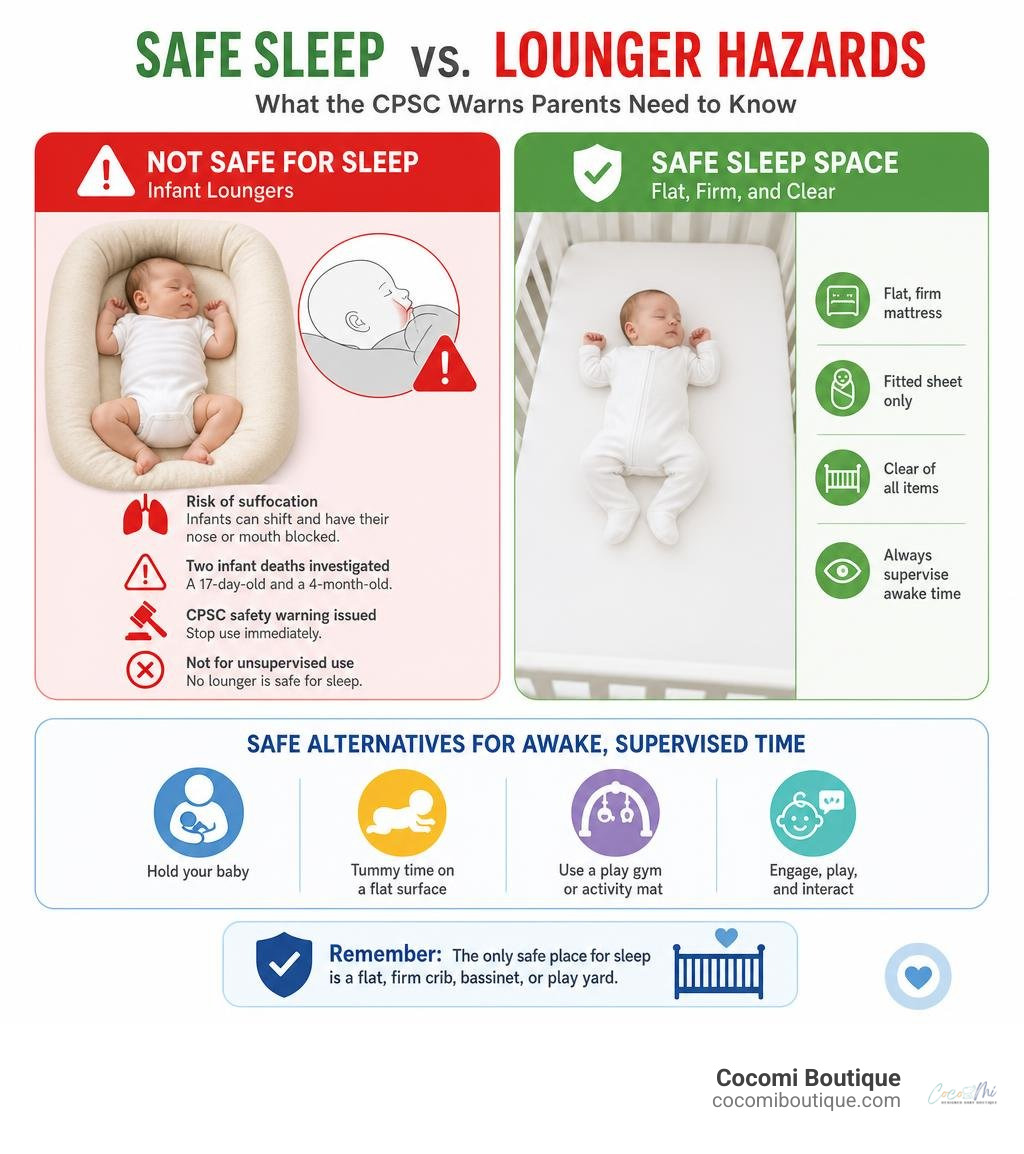
Here's the quick summary:
- The CPSC warns parents to immediately stop using the affected infant lounger models named in its safety warning
- The hazard is suffocation - infants can shift position and have their nose or mouth blocked by the product
- Two infant deaths have been investigated: a 17-day-old in January 2018 and a 4-month-old in December 2015
- The manufacturer refused a voluntary recall and challenged the CPSC's action
- New federal safety rules for infant support cushions took effect in May 2025, changing what products may be manufactured and sold
- No infant lounger is safe for unsupervised use or sleep - the only safe sleep surface is a flat, firm crib, bassinet, or play yard
The core issue is straightforward: even when a soft lounger is marketed for supervised, awake-time use only, it is foreseeable that tired babies may fall asleep in it. And when an infant shifts position inside deep, contoured sides, the results can be fatal.
I'm Monika Jarog, and as a designer of handcrafted, natural baby essentials - including baby nests and nursing pillows built to the highest European safety standards - understanding the difference between a safe sleep space and a lounging product is something I care deeply about when reviewing any infant lounger alternative. In this guide, I'll walk you through the safety concerns, the regulatory timeline, and what genuinely safe options look like for your baby.
Quick look at infant lounger safety and alternatives:
Understanding the Affected Infant Lounger and Its Intended Use
To understand why this style of product became the center of a federal safety dispute, we first need to look at what the affected infant lounger is and how it was designed to function.
Initially launched in 2009 by a family-owned baby product manufacturer operating out of Oklahoma, this lounger was marketed as a sling-style infant seat. It quickly gained popularity among new parents looking for a cozy spot to set their babies down during awake moments.
For parents in our local Chicago suburbs, from Northbrook and Deerfield to Glenview and Highland Park, loungers like this seemed convenient. They offered a way to keep a newborn nestled close while parents managed daily household tasks.

Design Features of the Affected Infant Lounger
The lounger measures approximately 23.75 x 21.5 x 8 inches, with a total circumference of roughly 71 to 75 inches. Its defining feature is a contoured, sling-style seat nestled inside deeply padded, raised edges.
The design relies on a deeply concave center that sinks under the baby's weight, suspended by a fabric sling. This creates a cozy, nested sensation that naturally keeps the infant in a semi-reclined, elevated position. According to manufacturer descriptions, this upper body elevation was intended to assist with infant digestion and breathing, making products like this popular among families searching for a Baby Lounger Complete Guide to help understand infant comfort products.
The outer cover is typically made of polyester and cotton blends, designed to be removable and machine washable. While these features make this type of lounger convenient for managing spit-up and everyday messes, the very elements that make it feel so cozy - the deep, soft contours and padded sides - are exactly what pose a severe risk to a sleeping baby.
Intended Use vs. Foreseeable Misuse
The product was designed and marketed strictly for supervised, awake-time lounging. It was meant to be a hands-free aid for parents who needed to free their hands for a few minutes to prep a bottle, pay bills, or care for siblings, all while keeping a close eye on their awake baby.
However, there is a massive gap between how a product is intended to be used and how it is foreseeably used in the real world. This concept of foreseeable misuse is at the heart of the regulatory action.
When a tired newborn is placed in a warm, contoured, elevated cushion, they may fall asleep. For an exhausted parent, a sleeping baby can feel like a relief, and the temptation to let them snooze undisturbed is incredibly strong. Furthermore, social media platforms have historically been flooded with images of peaceful, sleeping infants nestled in cozy loungers, inadvertently reinforcing the idea that these products are safe for naptime.
As detailed in our Portable Infant Lounger Complete Guide, infant loungers lack the rigid sides and flat, firm surfaces required to keep a sleeping baby's airway clear. When a lounging pad is used for unsupervised sleep, the risk of a life-threatening accident increases exponentially.
The CPSC Safety Warnings and Reported Incidents
The U.S. Consumer Product Safety Commission (CPSC) is the federal agency responsible for protecting the public from unreasonable risks of injury or death associated with consumer products. When patterns of injury or death emerge, the CPSC steps in to warn the public and seek recalls.
Why This Infant Lounger Is Not Safe for Sleep
The primary hazard associated with the affected infant lounger is suffocation and positional asphyxia. Because it features deeply contoured, plush sides and a flexible fabric sling, an infant who is left unsupervised can shift, roll, or slide.
If a baby turns their head, rolls to the side, or slumps down into the fabric, their nose and mouth can quickly become pressed against the soft padding or the fabric sling. Because infants have limited neck strength, they may be unable to extricate themselves from this position. Suffocation can occur in as little as three to ten minutes if a baby's airway is completely obstructed.
Additionally, biomechanical testing conducted during federal investigations found that the concave design allowed for significantly greater trunk and hip flexion than a flat crib mattress. This flexed position can facilitate rolling movements - even in infants who are not yet developmentally able to roll over on a flat surface.
The CPSC reported that approximately 180,000 units had been sold and investigated two tragic infant deaths connected to the affected product line:
- December 2015: A four-month-old infant died of asphyxia complications at a daycare center after being placed face-up or on his side in the lounger inside a crib, and later found face-down.
- January 2018: A 17-day-old infant died in a co-sleeping environment after being placed face-up in the lounger on an adult bed between caregivers, eventually shifting off the product and suffocating.
These incidents underscore a crucial safety message that we echo in our guide, Nest or No Nest: Decoding Safe Sleep for Your Newborn: soft, inclined, or contoured surfaces are fundamentally incompatible with safe infant sleep.
Timeline of CPSC Warnings and Legal Actions
The regulatory dispute over the affected lounger has been long and highly contested. Here is how the timeline unfolded:
- January 2022: The CPSC issued an official press release warning consumers to immediately stop using the affected infant loungers due to suffocation hazards and two investigated infant deaths. You can visit the CPSC consumer warnings page for official safety notices.
- February 2022: After the manufacturer declined to initiate a voluntary recall, the CPSC took the rare step of filing an administrative complaint against the company. The lawsuit sought to force the company to notify the public of the alleged defect and offer refunds to consumers. Related agency announcements are available through the CPSC newsroom.
- Legal Proceedings (2022-2024): The manufacturer defended the product, arguing that the loungers are safe when used as directed and that the CPSC was overstepping its authority by trying to hold manufacturers responsible for parental misuse.
The legal documents from this battle, including COMPLAINT COUNSEL'S MEMORANDUM IN SUPPORT OF MOTION FOR PARTIAL SUMMARY DECISION AND STATEMENT OF UNDISPUTED MATERIAL FACTS, show the deep divide between federal safety advocates and the manufacturer.
The Manufacturer's Response and the Changing Regulatory Landscape
The manufacturer's response to the CPSC's allegations has been one of firm resistance. The company consistently defended the design and utility of its products and maintained that the affected lounger was intended only for supervised, awake use.
The Manufacturer's Legal Defense and Position
The manufacturer's position was built on the argument that the product was not defective. The company asserted that the lounger was safe for its intended use: supervised, awake-time lounging. It argued that the tragic deaths associated with the product occurred because caregivers did not follow warning labels stating that the lounger should never be used for sleep, co-sleeping, or unsupervised time, and should only be placed on the floor.
To fight the CPSC's administrative action, the manufacturer partnered with the Pacific Legal Foundation and filed a federal lawsuit against the CPSC. The company argued that the government was trying to ban a useful product because some consumers chose to ignore safety warnings. It also maintained that parental education, rather than product bans, is the key to infant safety.
Despite this defense, the legal pressure and shifting regulatory landscape ultimately changed the product's availability.
New Federal Safety Standards for Infant Support Cushions
While the legal battle between the manufacturer and the CPSC played out, federal regulators worked to establish broad, industry-wide safety standards to prevent these hazards from reaching store shelves in the first place.
In late 2024, the CPSC finalized two major rules aimed at protecting infants from soft bedding hazards:
- The Infant Support Cushion Rule: Approved on November 4, 2024, with an effective date of May 5, 2025. This safety standard targets products like infant loungers, requiring them to meet strict firmness and airflow tests to help reduce suffocation hazards if a baby rolls over.
- The Nursing Pillow Rule: Approved on October 25, 2024, with an effective date of April 23, 2025, regulating the firmness and shape of nursing support cushions.
Because the affected infant lounger models could not meet these strict new federal firmness and airflow standards, manufacturing of the product line was discontinued in compliance with the May 2025 deadline.
For parents navigating these changes, we broke down the safety implications of these new rules in our article, The Truth About Newborn Snuggle Nests: Safety, Benefits, and What to Consider.
Safe Sleep Practices and Premium Alternatives
As parents, our absolute top priority is keeping our little ones safe. Understanding what constitutes a safe sleep environment is the first step in protecting your baby from sleep-related hazards.
AAP Guidelines for Safe Infant Sleep
The American Academy of Pediatrics (AAP) provides clear, evidence-based guidelines for reducing the risk of Sudden Infant Death Syndrome (SIDS) and accidental suffocation. These guidelines are often referred to as the ABCs of Safe Sleep:
- A - Alone: The baby should sleep alone in their own designated sleep space. Keep the sleep area free of soft objects, toys, pillows, blankets, and padded crib bumpers.
- B - Back: Always place your baby on their back for every sleep - both naps and nighttime. Once your baby can roll over comfortably in both directions, you do not need to flip them back, but always start them on their back.
- C - Crib: Place your baby on a firm, flat, non-inclined surface, such as a crib, bassinet, or play yard, that meets current federal safety standards. Use only a tight-fitting sheet designed specifically for that mattress.
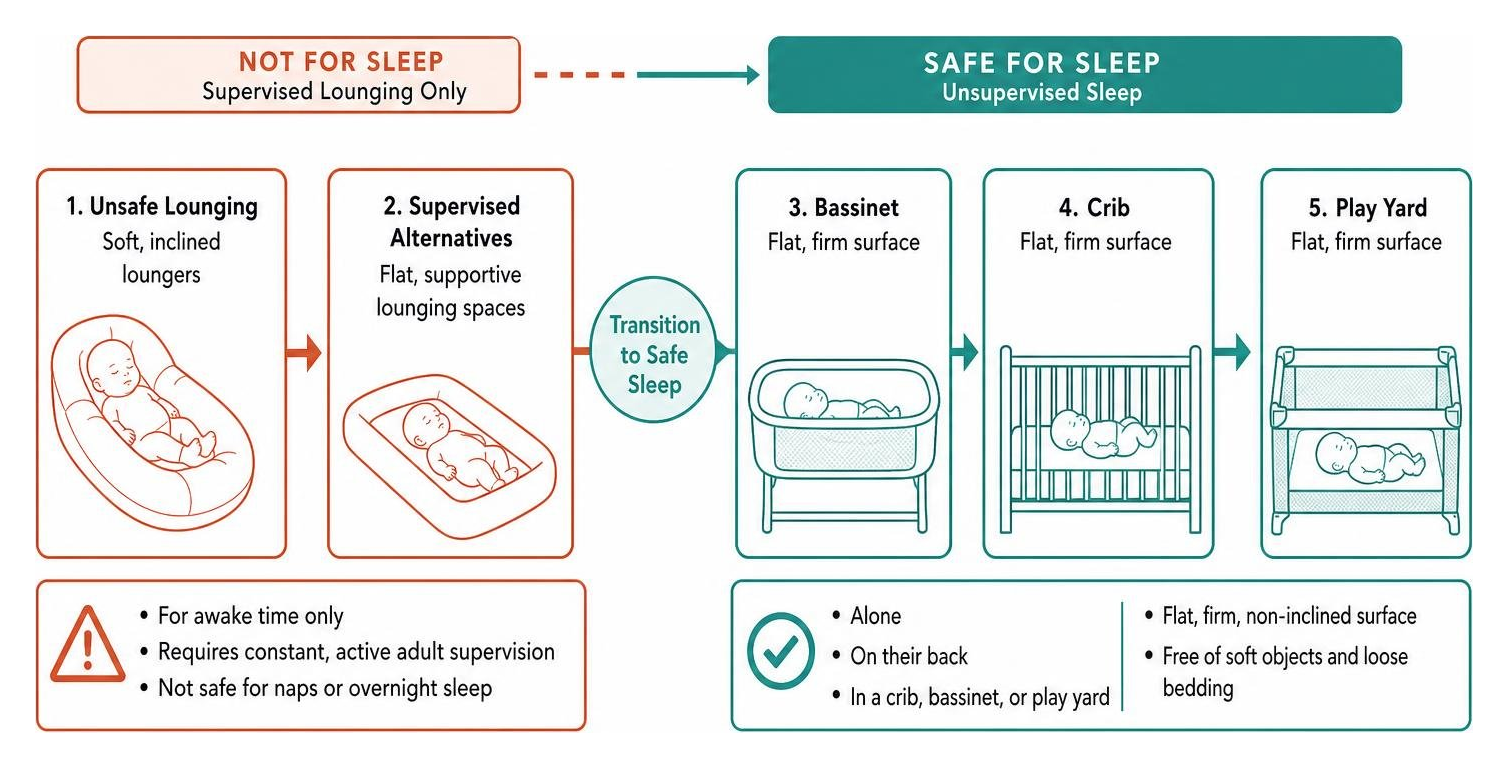
To help visualize the differences between safe sleeping environments and products designed strictly for supervised lounging, we have put together this comparison table:
| Feature | Safe Sleep Environment (Crib, Bassinet, Play Yard) | Lounging Space (Infant Lounger, Baby Nest for Awake Use) |
|---|---|---|
| Surface Firmness | Extremely firm; does not indent under baby's weight | Soft, plush, or contoured; may conform to baby's body |
| Incline | Flat (0-degree angle) | May be reclined, elevated, concave, or softly bordered |
| Side Construction | Rigid wooden/plastic slats or breathable mesh | Soft fabric borders or supportive cushions |
| Supervision Required | Safe for unsupervised overnight and nap sleep | Requires constant, active adult supervision |
| Intended Activity | Unsupervised sleep and rest | Awake lounging, tummy time, or supervised play |
If you want to dive deeper into how to set up a safe nursery, check out our guide on the Portable Infant Lounger Bassinet.
Safe Supervised Alternatives for Daytime Lounging
If you are looking for a comfortable place to lay your baby down during awake daytime moments while you are in the room, choose products that are clearly intended for supervised use and made with safety-conscious materials.
At Cocomi Boutique, we believe in creating beautiful, functional, and safe spaces for your newborn. If you want a dedicated lounging spot for supervised, awake daytime use, we recommend choosing premium, handcrafted baby nests made from natural, chemical-free, and OEKO-TEX certified materials.
Our baby nests are designed with flat, supportive mattresses and low, comfortable edges for supervised awake time. They are lovely for floor lounging, tummy time, and interactive play when an adult is actively watching. When paired with our organic cotton muslin swaddles, baby blankets, Moses baskets, nursery organizers, and newborn clothing, they help create an elegant, coordinated nursery filled with natural textures and thoughtful design.
You can explore our curated collection of handcrafted, natural baby essentials on our Cocomi Boutique blog and online store.
Frequently Asked Questions about the Affected Infant Lounger
Is the affected infant lounger currently recalled?
Technically, no. There has not been a formal, voluntary recall because the manufacturer refused to agree to one, leading to administrative litigation with the CPSC. You can learn more about CPSC recall and legal actions through the agency's official recalls page.
However, because federal safety standards for infant support cushions went into effect in May 2025, manufacturing of the affected product line was discontinued. The product is no longer sold by authorized retailers.
Can I still use my affected infant lounger if I supervise my baby?
The CPSC strongly advises consumers to immediately stop using the affected models due to the risk of positional asphyxia and suffocation. If you choose to keep using a similar infant lounger you already own, it must only be used for awake, supervised lounging on the floor, and you must never let your baby sleep in it.
If you have experienced any safety incidents or close calls with an infant lounger, you can report them directly to the federal database at saferproducts.gov.
What should I do if my baby falls asleep in a lounger?
If your baby falls asleep in any infant lounger, nursing pillow, baby nest, or inclined seat, you should immediately transition them to a safe, flat sleep surface, such as a crib, bassinet, or play yard. Never leave a sleeping baby in a lounger, even if you are in the same room.
Conclusion
The safety warnings surrounding soft, contoured infant loungers serve as an important reminder of how critical safe sleep environments are for our babies. While cozy loungers are highly appealing, they do not provide the flat, firm, and unobstructed surfaces that infants need to breathe safely while sleeping.
At Cocomi Boutique, we are dedicated to helping families navigate early parenthood with peace of mind. We design our handcrafted baby nests, organic blankets, muslin swaddles, nursing pillows, Moses baskets, nursery essentials, and baby clothing with a strict commitment to safety, natural materials, and timeless design. By choosing high-quality, chemical-free products and following safe sleep guidelines, you can create a beautiful, serene, and safe environment for your little one to grow.
We invite you to explore our thoughtfully designed collection of premium baby essentials at Cocomi Boutique. Let us help you style a nursery that is as safe as it is beautiful!