

Why Learning How to Use a Baby Wrap Changes Everything for New Parents

Knowing how to use a baby wrap is one of the most practical skills you can learn as a new parent. It keeps your baby close, supports healthy development, and frees up your hands for everyday life.
Here's the quick version:
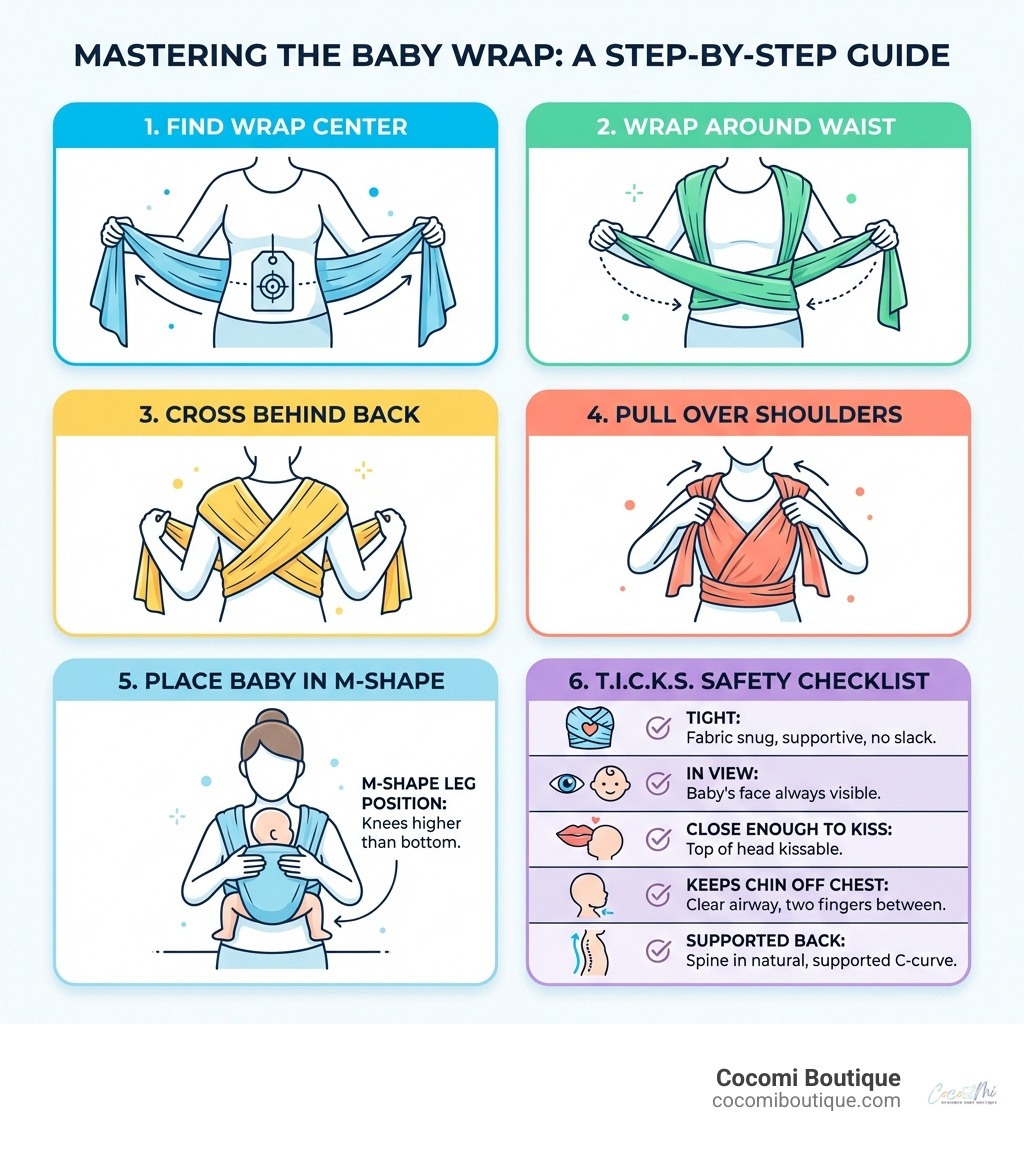
- Find the middle of the wrap using the center tag or marker, and place it against your stomach.
- Wrap both ends around your waist, then cross them behind your back in an X shape.
- Bring both ends over your shoulders and pull them through the front panel.
- Cross the ends behind your back again and tie a secure double knot at the front or back.
- Place your baby in, one leg at a time, spreading the fabric from knee to knee under their bottom.
- Check the T.I.C.K.S. rule: fabric is Tight, baby is In view, Close enough to kiss, Keeps chin off chest, and back is Supported.
It sounds like a lot at first. But after a few tries, it becomes second nature — and both you and your baby will love it.
Wraps come in two main types: stretchy (great for newborns) and woven (better for older, heavier babies). Each has a different tying method, and we'll walk through both clearly below.
I'm Monika Jarog, and through years of designing and curating handcrafted baby essentials — including premium baby wraps — I've helped many parents navigate babywearing confidently and safely. Understanding how to use a baby wrap properly is something I'm passionate about, because the right technique makes all the difference for both comfort and safety. Let's walk through everything you need to know, step by step.
How to Use Baby Wrap: Choosing the Right Style
Before we dive into the "how-to," we need to talk about the "what." Not all wraps are created equal. Walking into a babywearing community or a shop in the Chicago area can feel like entering a different world where everyone speaks in "GSM" and "blends." At Cocomi Boutique, we believe in keeping it simple.
There are two primary categories you need to know: stretchy wraps and woven wraps.
Stretchy Wraps
Think of a stretchy wrap like your favorite, most comfortable t-shirt. These are typically made from jersey cotton, often blended with bamboo for extra softness or a touch of spandex for "snap-back" elasticity.
- Pros: They are incredibly forgiving for beginners. You can "pre-tie" the wrap before you even leave the house and simply pop the baby in and out as needed. They provide a snug, womb-like environment that newborns crave.
- Cons: They have a weight limit. Most parents find that once a baby hits about 17–20 lbs, the fabric starts to sag or "bounce," making it uncomfortable for the wearer.
- Best For: The "fourth trimester" (birth to 6 months).
Woven Wraps
Woven wraps are the "Volkswagen Beetles" of the babywearing world—classic, durable, and capable of going the distance. They are made from sturdier fabrics like linen, hemp, or specialized woven cotton that has a diagonal stretch but doesn't stretch in length or width.
- Pros: They are incredibly versatile. You can use them for front, hip, and back carries. They can support a child from birth through the preschool years (up to 45 lbs or more).
- Cons: There is a steeper learning curve. You generally cannot pre-tie them; you tie the wrap around the baby each time to get the perfect tension.
- Best For: Parents who want one carrier to last for years.
| Feature | Stretchy Wrap | Woven Wrap |
|---|---|---|
| Material | Jersey Cotton, Bamboo, Spandex | Woven Cotton, Linen, Hemp, Silk |
| Ease of Use | High (Pre-tieable) | Medium (Requires practice) |
| Support | Best for newborns (<15-20 lbs) | Birth to Toddlerhood (up to 45 lbs) |
| Positions | Front carry only | Front, Hip, and Back carries |
| Breathability | Varies; Bamboo is cooler | High; depends on weave/blend |
Choosing the right material is essential for comfort, especially during our humid Illinois summers or chilly winters. For a deeper look at materials, check out our guide on breathable bliss: discovering the perfect organic baby wrap.
Essential Safety Guidelines and the T.I.C.K.S. Rule
Safety is the non-negotiable foundation of babywearing. When you are learning how to use baby wrap techniques, your baby’s airway and hip positioning must be your top priorities.
The industry standard for safety is the T.I.C.K.S. Rule:
- T — Tight: The wrap should be tight enough to hug your baby close to you. Loose fabric allows the baby to slump, which can restrict their breathing.
- I — In view at all times: You should always be able to see your baby’s face just by looking down. Never let the fabric cover their nose or mouth.
- C — Close enough to kiss: Your baby’s head should be positioned high on your chest. You should be able to tip your head forward and kiss the top of their forehead easily.
- K — Keep chin off chest: Ensure there is always a space of at least one finger-width under your baby’s chin. If their chin is pressed against their chest, it can restrict their airway.
- S — Supported back: In a snug wrap, the baby's back should be supported in its natural "C" curve.
Hip Health and the "M-Shape"
Beyond the airway, we must protect the baby's developing hips. According to scientific research on hip dysplasia, improper positioning where the legs hang straight down can increase the risk of hip issues.
When wrapping, aim for the "M-Position": the baby’s knees should be slightly higher than their bottom, with the fabric spreading from the back of one knee all the way to the back of the other. This ensures the hip socket is properly seated. For more on newborn safety, see the ultimate guide to safe swaddling for newborns.
Mastering the Basic Tying Technique
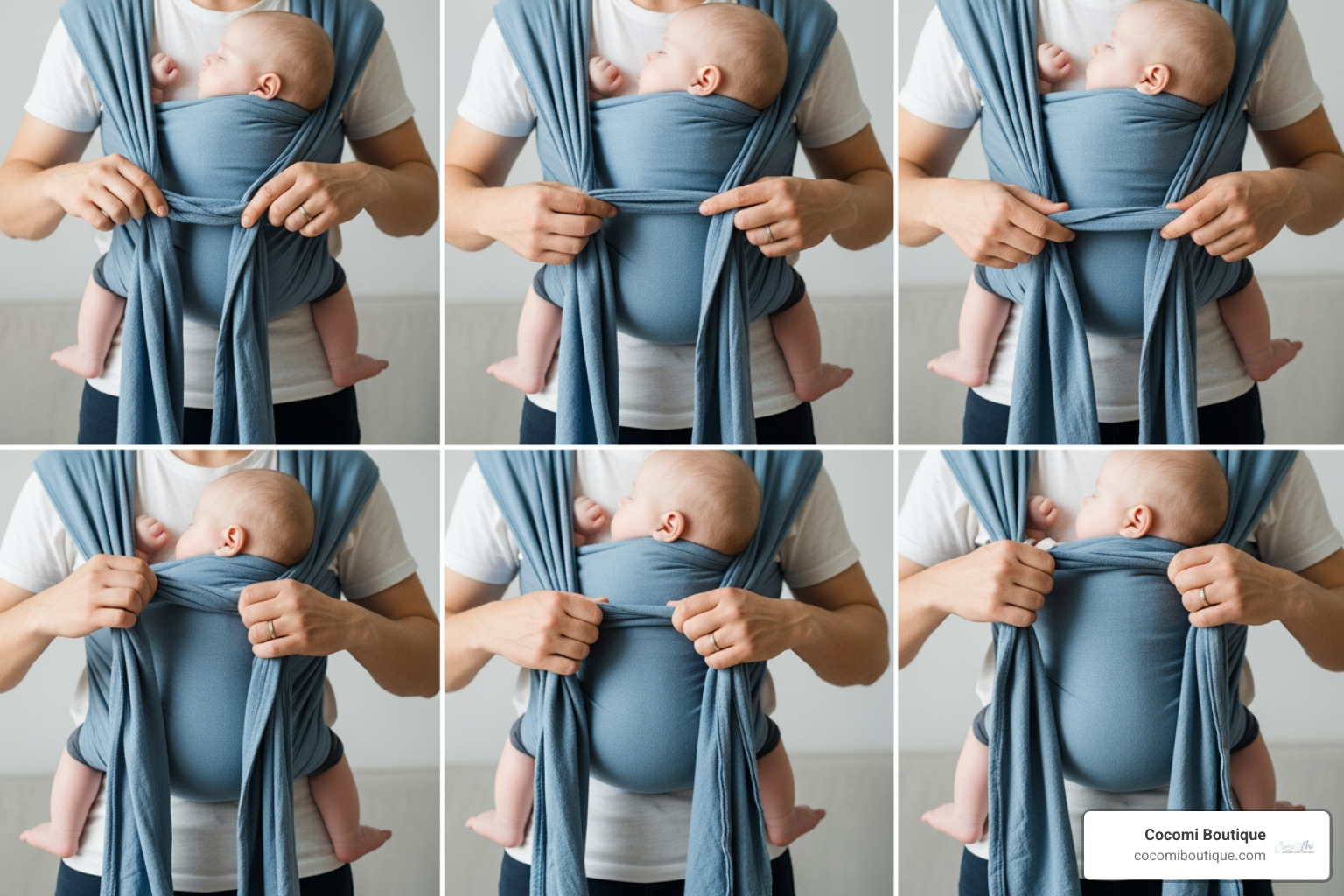
The most common way to start your babywearing journey is with a Pocket Wrap Cross Carry (PWCC) for stretchy wraps or a Front Wrap Cross Carry (FWCC) for woven wraps. While they look similar, the order of operations differs slightly.
The "Middle Marker" is your best friend. Most wraps have a tag or a logo in the exact center of the fabric. Always start by finding this marker.
The Foundation Steps:
- Center: Place the middle marker at your navel (belly button).
- Cross: Take the ends behind your back, cross them to form an "X," and bring them up over your opposite shoulders.
- The "Pocket": For a stretchy wrap, tuck the ends under the horizontal band at your waist. For a woven wrap, you will usually create the pocket around the baby.
- The Double Knot: Always finish with a secure double knot. If you have a lot of extra fabric, you can wrap it back around to your front and tie it there.
Step-by-Step: How to Use Baby Wrap for a Front Carry
Let’s walk through the most popular beginner carry: the Front Wrap Cross Carry. This is the gold standard for learning how to use baby wrap styles effectively.
- Find the Middle: Hold the center of the wrap against your chest.
- Back Cross: Pass the fabric around your waist, cross it behind your back, and bring the tails over your shoulders. You should now have a horizontal "pass" across your stomach and two "straps" over your shoulders.
- Create the Seat: Pick up your baby and rest them against your shoulder. Slide one leg under the horizontal pass, then the other.
- Spread the Fabric: Pull the top edge of the horizontal pass up to the baby’s neck. Pull the bottom edge down under their bottom and tuck it up between you and the baby to create a "seat."
- Tighten: Pull the shoulder straps upward to remove slack. One at a time, pull the straps across the baby’s back, crossing them under the baby's bottom.
- Secure: Bring the tails under the baby’s legs and tie a double knot behind your back.
For visual learners, watching tutorials can help you see exactly how to manage the tension.
How to Use Baby Wrap for Newborns Safely
Newborns require a bit more finesse. Their neck muscles aren't yet strong enough to support their heads, and they often prefer a more tucked-in position.
- Newborn Hug Hold: This is a variation where the baby's legs can remain tucked inside the wrap in a "fetal" or "froggy" position if they are very small (under 8 lbs), though most consultants now recommend legs-out from birth for better hip positioning.
- Neck Support: If your baby falls asleep, you can gently tuck the back of their head under one of the shoulder passes to provide support. Never cover their face.
- The Kiss Test: New parents often wear the baby too low. If you have to strain your neck to kiss their head, the wrap is too loose or too low.
Check out this specific guide on the newborn hug hold to see the nuances of infant positioning.
Troubleshooting and Advanced Carrying Positions
Even with the best instructions, you might run into a few "wrap rages" in the beginning. Don't worry—it happens to the best of us!
Common Issues
- Baby is Slumping: This usually means the wrap is too loose. Take the baby out and re-tie it tighter. A stretchy wrap should feel like a tight swimsuit before you put the baby in.
- Fabric in Baby’s Face: If the shoulder straps are too close to the baby's mouth, "cap" the fabric over your shoulders (pull it down toward your elbows) to open up the view.
- Lower Back Pain: This often happens if the "X" on your back is too high. Pull the intersection of the "X" down toward the middle of your back to distribute the weight better.
Advanced Positions
Once you’ve mastered the front carry, a whole world of possibilities opens up:
- Hip Carry: Great for babies who are 4–6 months old and want to see the world but still need the security of being close to you.
- Back Carry: Note: Only attempt back carries with a woven wrap once your baby has strong head and neck control (usually 6 months+). Never back carry in a stretchy wrap as the fabric can't support the weight safely.
- Breastfeeding: You can breastfeed in a wrap by loosening the knot slightly and lowering the baby to chest height. Once finished, always move the baby back up to the "close enough to kiss" position and re-tighten.
For more tips on using wraps for sleep and comfort, see mastering the muslin swaddle: how to wrap your baby for sweet dreams.
Frequently Asked Questions about Baby Wrapping
When should I switch from a stretchy wrap to a woven one?
Most parents make the switch when the baby reaches about 15–17 lbs. You’ll know it’s time when you feel like you have to keep re-tightening the wrap every 20 minutes because the baby’s weight is causing the fabric to sag. Woven wraps provide the structural integrity needed for heavier infants and toddlers.
Can I breastfeed while using a baby wrap?
Yes! It is one of the biggest "pro tips" for hands-free parenting. For a stretchy wrap, you can shift the baby down to the breast. For a woven wrap, you may need to loosen the carry slightly. Always maintain a hand on the baby while nursing and ensure their chin is not pressed against their chest. Once they are done, reposition them immediately to the safe upright position.
How do I choose the right size for a woven wrap?
Woven wraps use a sizing system (Size 2 through Size 8).
- Size 6 (approx. 4.6 meters) is the "Base Size" for most average-sized adults and allows for almost every type of carry.
- Size 4 or 5 is great for shorter carries or petite parents.
- Size 7 or 8 is recommended for taller or plus-sized parents to ensure enough tail length for a double knot.
Conclusion
Learning how to use baby wrap carriers is a journey of practice and patience. Don't be discouraged if your first few attempts feel clunky or if your baby gets a little fussy. We always recommend practicing with a doll or a bag of flour first to get the "muscle memory" of the tying technique down.
Once you find your rhythm, you’ll realize that a wrap isn't just a piece of fabric—it's a tool that allows you to navigate the grocery stores in Glenview, walk the trails in Buffalo Grove, or simply enjoy a warm cup of coffee in your Northbrook home while your baby naps peacefully against your heart.
At Cocomi Boutique, we are committed to providing you with the highest quality essentials for your parenting journey. From our family in the Chicago suburbs to yours, we wish you many happy hours of babywearing.
Explore our latest baby care guides for more tips on making the most of these precious early years.