

Why OEKO-TEX Certified Baby Products Are Worth Your Attention

OEKO-TEX certified baby products have been independently tested against over 1,000 harmful substances — giving parents a reliable, science-backed way to know what's actually touching their newborn's skin.
Here's a quick answer to what this certification means for your baby:
| What You Want to Know | The Short Answer |
|---|---|
| What is OEKO-TEX? | An independent certification that tests textiles for harmful chemicals |
| Which class covers babies? | Product Class I — the strictest level, for children up to 3 years |
| What does it test for? | Formaldehyde, heavy metals, phthalates, pesticides, carcinogenic dyes, and 1,000+ more |
| Does it cover the whole garment? | Yes — fabric, threads, buttons, zippers, labels, and prints |
| How often is it renewed? | Annually, with limit values reviewed at least once a year |
| How do you verify it? | Use the official OEKO-TEX Label Check tool with the certificate number |
Babies spend up to 20 hours a day in direct contact with clothing and bedding. That's a lot of skin-to-fabric time — especially for newborns whose skin is thinner, more absorbent, and far more sensitive than an adult's. What's woven into a fabric matters enormously at this stage of development.
Not all baby products carry this certification. It's voluntary. And without it, there's no independent guarantee that a product is free from chemicals that could irritate, harm, or affect your baby's health.
This guide walks you through everything you need to know — from what OEKO-TEX actually tests, to how it compares with organic certifications like GOTS, to how to spot a genuine certified product.
I'm Monika Jarog, founder of Cocomi Boutique, where every product — from baby nests and muslin swaddles to Moses baskets and nursing pillows — is crafted from 100% natural, chemical-free materials that meet the highest European safety standards, including OEKO-TEX certified baby essentials. Choosing safe, handcrafted products for your little one is at the heart of everything we do, and I'm passionate about helping parents cut through the noise and make truly informed choices.
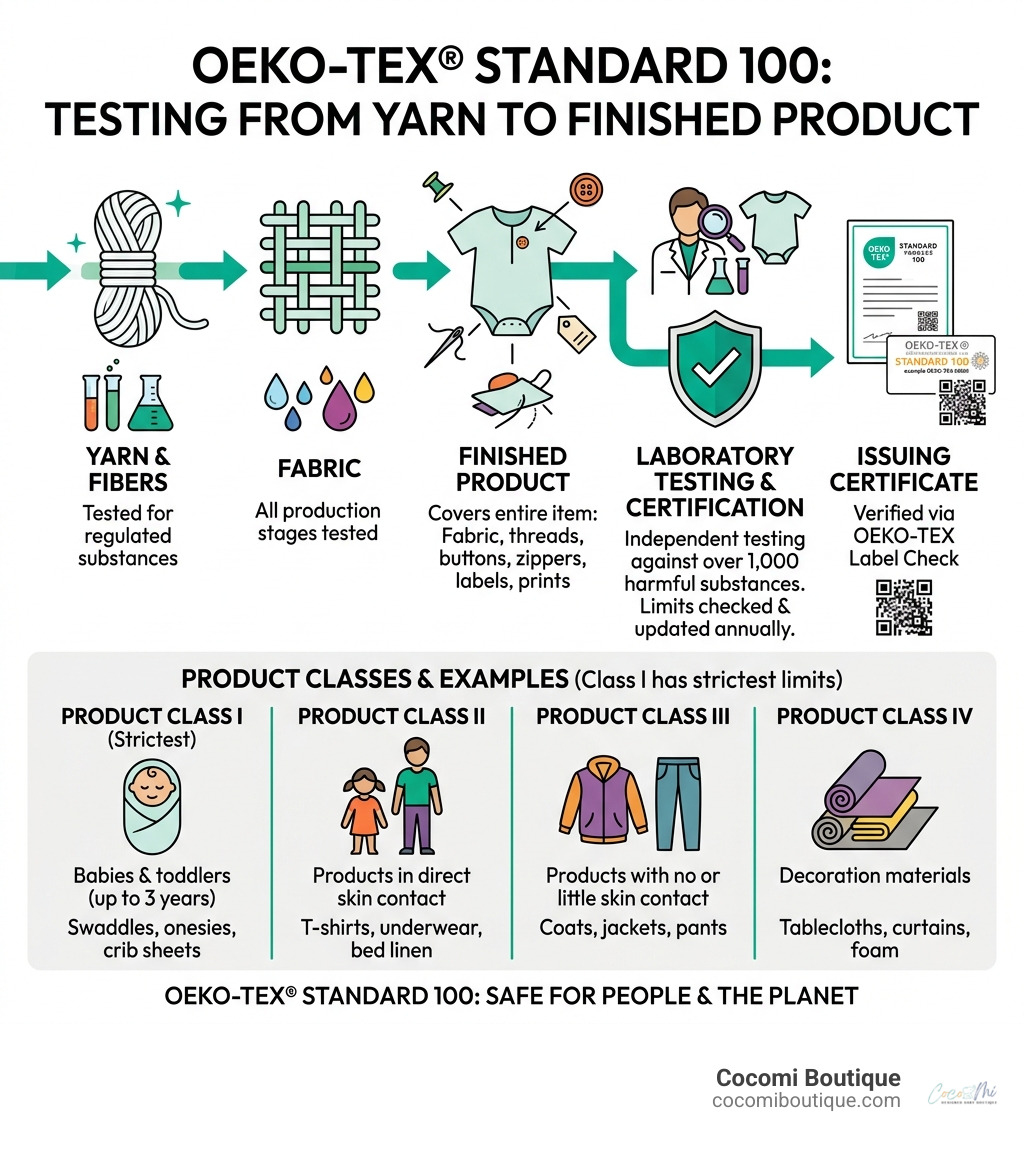
The Vital Role of OEKO-TEX certified baby Products in Infant Safety
When we bring a new baby home to Northbrook or Chicago, our first instinct is to protect them. We baby-proof the corners and check the car seat, but we often overlook the very thing wrapped around them all day: their clothes and blankets.
Infant skin is uniquely vulnerable. It is significantly thinner than adult skin, meaning it absorbs substances more easily. Because babies spend nearly 20 hours a day in direct contact with fabrics—from their organic cotton swaddle blankets to their crib sheets—the chemical makeup of those textiles is a major health factor.

The OEKO-TEX certified baby standard, specifically the OEKO-TEX® STANDARD 100, acts as a rigorous shield. It tests for over 1,000 harmful substances that are often used in textile manufacturing but are invisible to the naked eye. This isn't just about "natural" vs. "synthetic"; it's about ensuring that the final product—the one your baby is chewing on or sleeping in—is chemically safe. For more information on building a safe environment, check out our guide on organic baby essentials.
Why OEKO-TEX certified baby Items Must Meet Product Class I
Not all OEKO-TEX labels are created equal. The certification is divided into four distinct classes based on the intensity of skin contact and the sensitivity of the user. For our little ones, only Product Class I will do.
Product Class I is the strictest category, designed specifically for babies and toddlers up to three years of age. Why the extra rigor? Because babies have a habit of "mouth-testing" everything. The requirements for Class I include:
- Saliva Resistance: Dyes and finishes must not bleed or leach out when a baby sucks on the fabric.
- Strict pH Values: The fabric must match the skin's natural, slightly acidic pH to prevent irritation or "diaper rash" style reactions.
- Zero Carcinogenic Dyes: Absolutely no dyes known to cause cancer are permitted.
- Minimal Formaldehyde: While some industries allow higher levels, Class I sets the limit near zero to protect developing respiratory systems.
- No Heavy Metals or Phthalates: These substances, often found in plastic snaps or bright prints, are strictly prohibited due to their impact on hormonal development.
Key Benefits for Newborn Health and Development
Choosing OEKO-TEX certified baby gear offers more than just a label; it provides tangible health benefits. By eliminating toxic residues, you significantly reduce the risk of contact dermatitis and skin allergies. Many parents in our Illinois communities, from Riverwoods to Glencoe, find that switching to certified fabrics helps clear up mysterious skin redness.
Furthermore, non-toxic dyes and finishes contribute to better respiratory health. Textiles can "off-gas" volatile organic compounds (VOCs), which a baby breathes in while sleeping. A certified environment ensures the air in the nursery remains as pure as possible. Most importantly, it provides you with peace of mind. When you wrap your little one in a muslin blanket, you can rest easy knowing it’s been tested by 18 independent labs across Europe and Japan.
Decoding the Standard: Components, Testing, and Annual Updates
The genius of the OEKO-TEX system is its "modular" approach. To certify a finished garment, every single component must pass the test. This means a shirt isn't "safe" just because the cotton is clean; the thread used to sew the seams, the buttons on the front, and even the brand label inside must meet the same strict criteria.
| Product Class | Intended Use | Strictness Level |
|---|---|---|
| Class I | Babies & Toddlers (up to 3 yrs) | Highest / Strictest |
| Class II | Direct skin contact (blouses, underwear) | High |
| Class III | No skin contact (jackets, coats) | Medium |
| Class IV | Decoration/Home (curtains, table cloths) | Standard |
In our boutique, we prioritize this level of detail. Whether it’s the cotton muslin blankets or our handcrafted Moses baskets, we ensure the materials respect these global benchmarks. Buttons are tested for lead, zippers for nickel release, and prints for phthalates. If one tiny thread fails, the whole product fails.
Crucially, these standards are not static. OEKO-TEX reviews its limit values at least once a year to stay ahead of new scientific research. A product certified in 2023 must be re-tested and re-certified for 2024 to ensure it complies with the latest health findings.
How to Authenticate Your OEKO-TEX certified baby Essentials
With "greenwashing" on the rise, it’s important to know how to verify a claim. A genuine OEKO-TEX certified baby product will always display the Standard 100 label along with a unique certificate number and the name of the testing institute.
To verify a product:
- Locate the Certificate Number: Look for a string of numbers/letters on the tag (e.g., SHGO 069338).
- Use the Label Check Tool: Go to the official OEKO-TEX website and enter the number.
- Check the Status: The tool will tell you if the certificate is still valid and which product class it covers.
This level of transparency is why we love European craftsmanship. It allows parents from Highland Park to Winnetka to shop with confidence, knowing they aren't just buying a brand name, but a verified safety standard. For more tips on selecting the right items, see our guide on choosing the perfect organic baby gift set.
OEKO-TEX vs. GOTS: Choosing the Best for Your Little One
Parents often ask us: "Is OEKO-TEX the same as Organic?" The short answer is no, but they are great partners.
- GOTS (Global Organic Textile Standard): Focuses on the beginning of the journey. It ensures the cotton was grown without pesticides or GMOs and that the workers were treated fairly. It’s the gold standard for environmental and social responsibility.
- OEKO-TEX Standard 100: Focuses on the end of the journey. It tests the final product for chemical safety, regardless of whether the fibers are organic or synthetic.
You can actually have both! The OEKO-TEX® ORGANIC COTTON certification combines these worlds, verifying that cotton is organic while also testing for harmful residues. At Cocomi Boutique, we often use GOTS certified muslin because it ensures the highest purity from the farm to your baby's nursery.
Frequently Asked Questions about Textile Safety
Does OEKO-TEX cover all parts of a garment like buttons and zippers?
Yes, absolutely. One of the biggest misconceptions is that the certification only applies to the fabric. In reality, the OEKO-TEX Standard 100 is a "total garment" certification. This includes the sewing threads, the elastic bands, the zippers, the buttons, the snaps, and even the printed designs or labels. If any single component contains harmful levels of substances like lead or nickel, the entire item cannot be certified.
How often are certified products re-tested to maintain standards?
Certifications are only valid for 12 months. To maintain the label, manufacturers must undergo annual re-testing. Furthermore, OEKO-TEX updates its criteria every year based on the latest medical and scientific research. This ensures that as new chemicals are identified as potentially harmful, they are quickly added to the "prohibited" list.
What are the limitations parents should know when selecting certified products?
While OEKO-TEX certified baby products are the safest choice for chemical purity, the certification itself doesn't guarantee the "organic" status of the fiber (unless it's specifically the "Organic Cotton" label). It also doesn't necessarily dictate the "style" or "durability" of the garment. However, for parents prioritizing skin safety and non-toxic living, it remains the most reliable benchmark available globally.
Conclusion
At Cocomi Boutique, we believe that every snuggle should be a safe one. Our journey began with a simple mission: to provide parents with beautiful, handcrafted baby essentials that don't compromise on health. From our Northbrook roots to serving families across the Chicago area, we remain committed to premium materials and European-quality craftsmanship.
Choosing OEKO-TEX certified baby products is more than a shopping preference; it’s a proactive step in protecting your child's developing system. Whether you are looking for an elegant baby nest, a breathable swaddle, or a thoughtful gift, we invite you to explore our collection where style meets safety.
Ready to find the perfect, safe essentials for your little one? Explore our latest organic baby news and guides to learn more about our commitment to quality and care.